
Personalised decision engine
Wander
MY ROLE
SCOPE
PROJECT
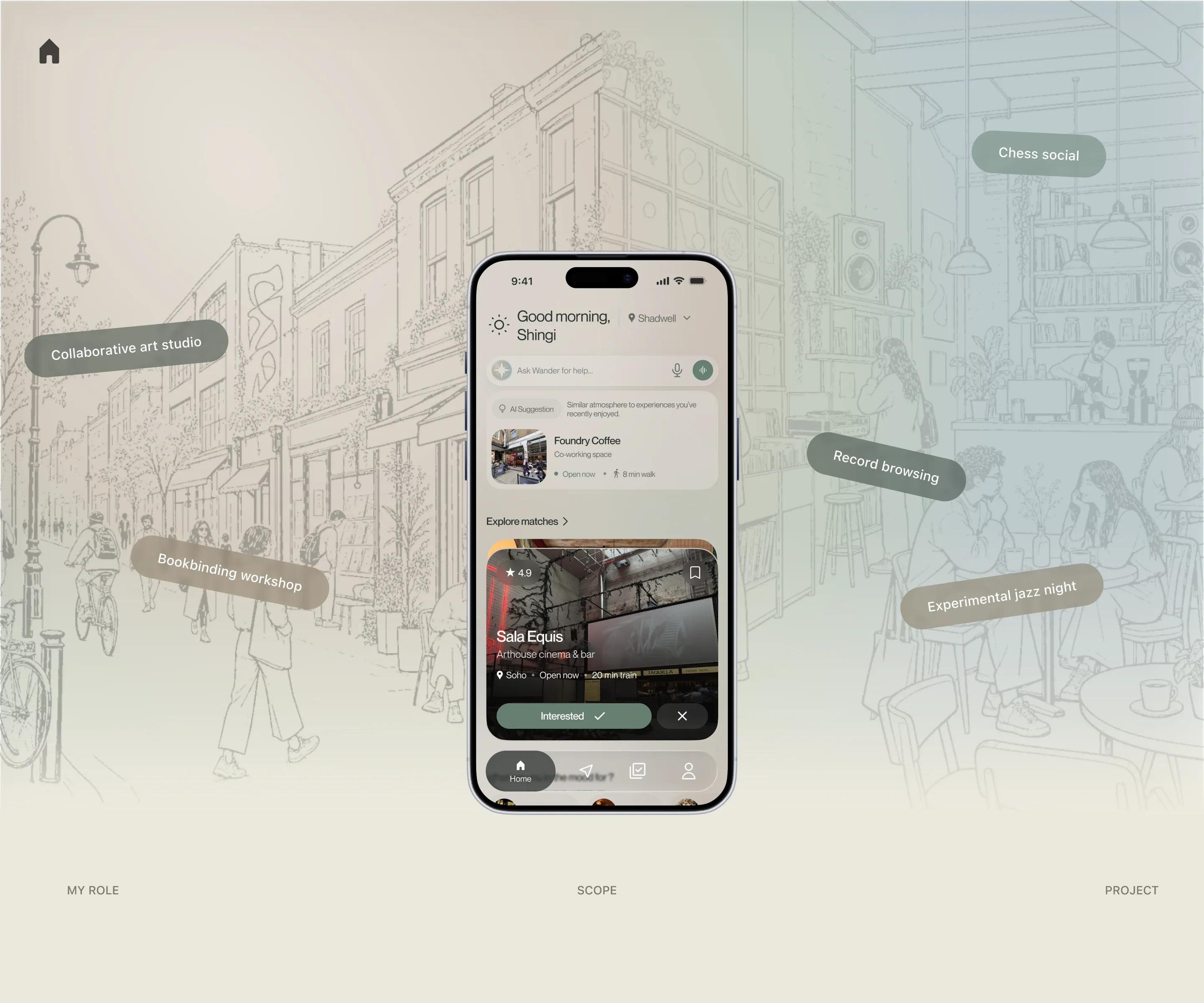
The city is full of possibilities.
But more choice doesn’t always bring better direction. More time searching can mean less time experiencing.
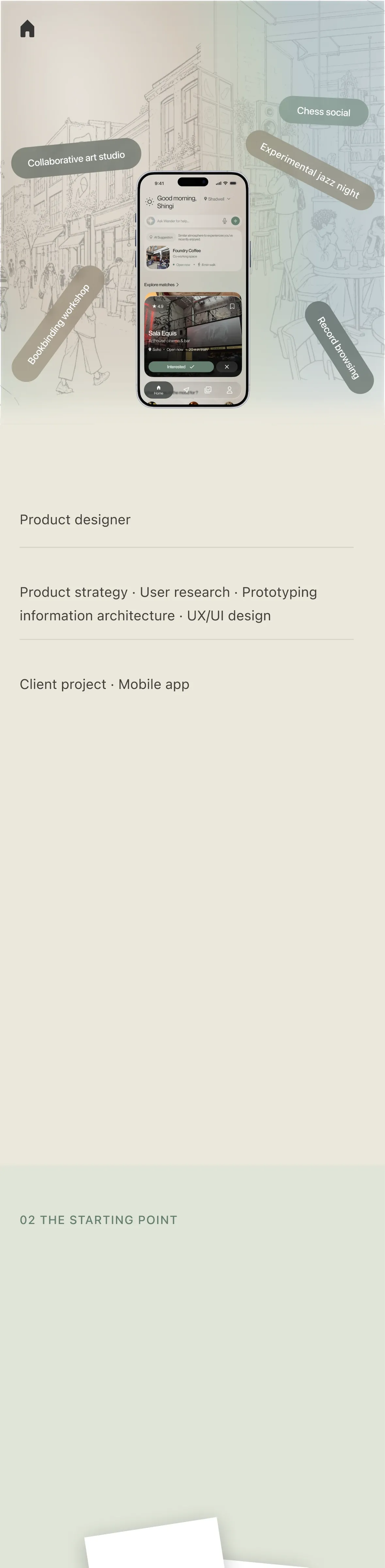
Wander is a personalised decision engine for places and events.
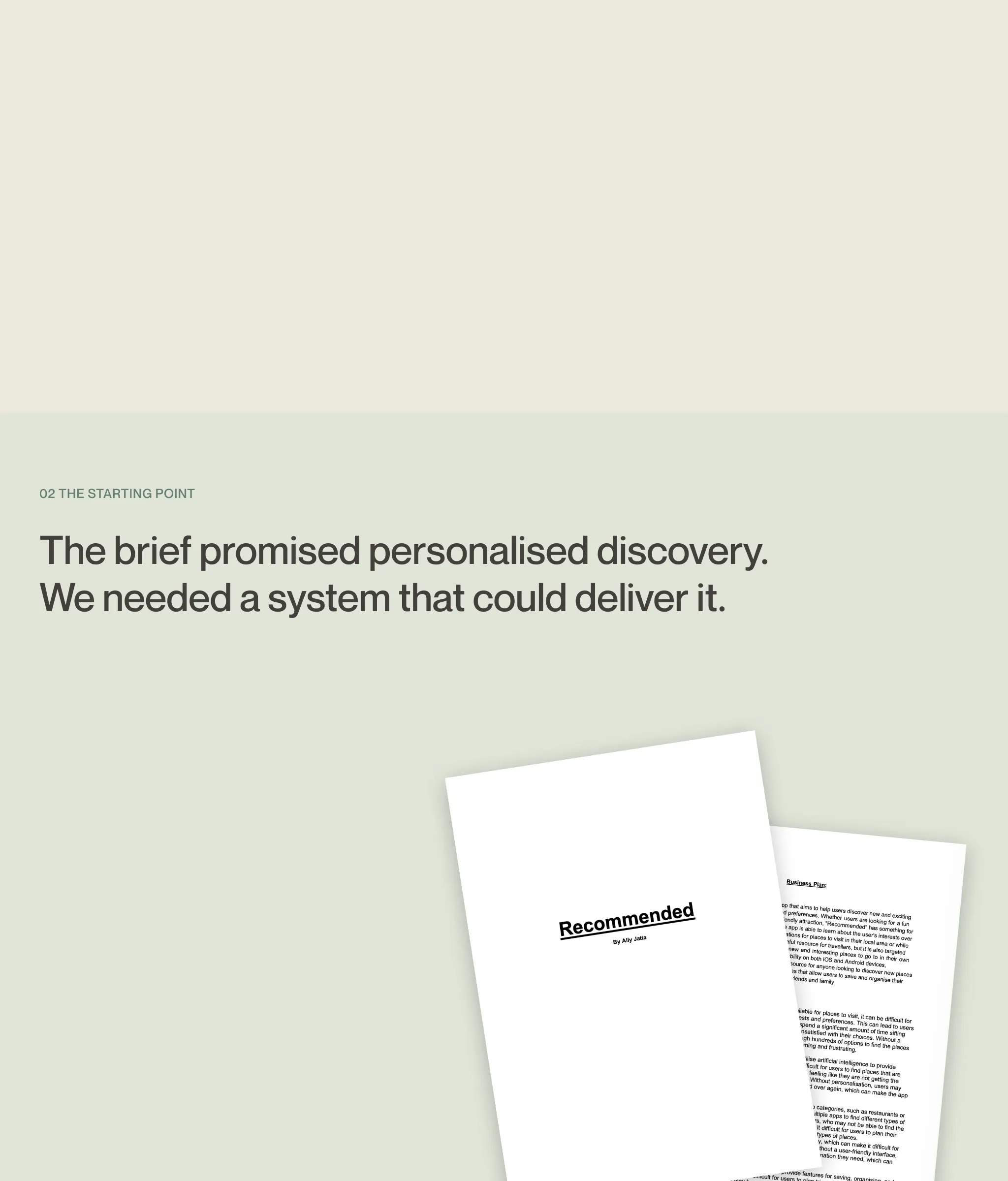
The brief promised personalised discovery. We needed a system that could deliver it.
The brief combined personalised recommendations with local and travel discovery, planning tools and detailed decision support.
Turning that promise into a product meant answering three questions:
How should context shape what surfaces?
Which behaviours reveal what genuinely resonates?
What builds confidence to choose?
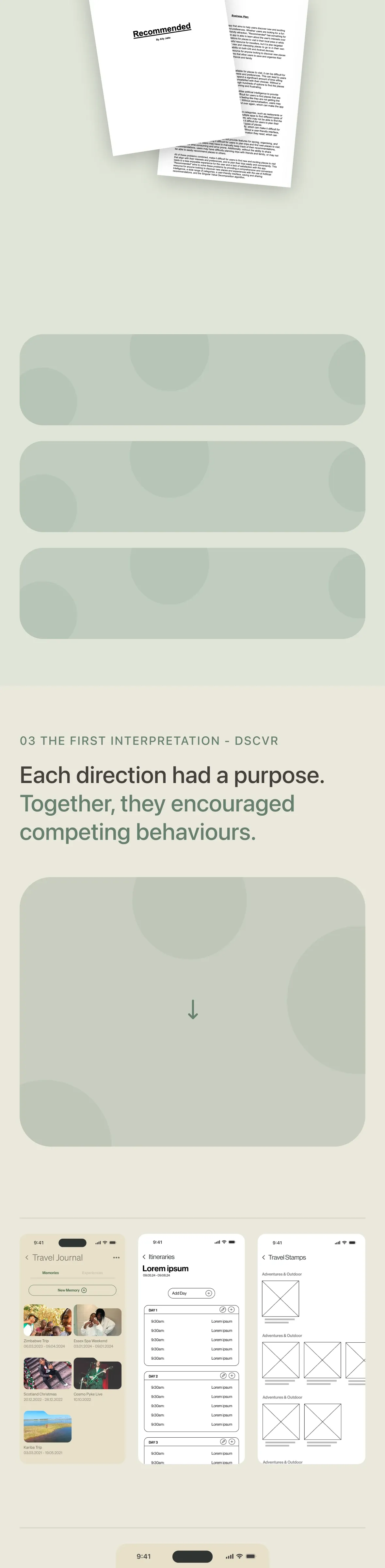
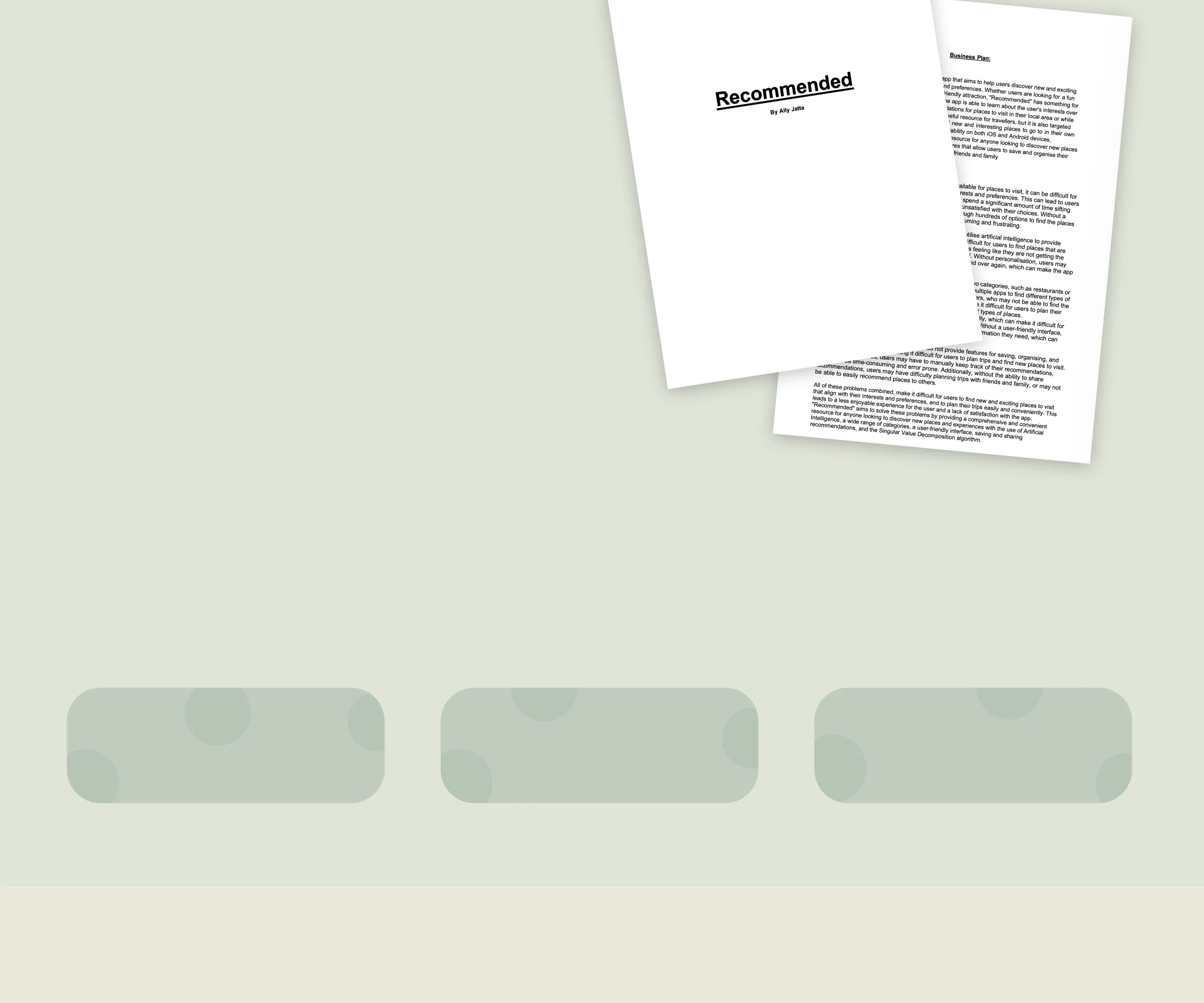
Recommended
Named the output
DSCVR
Named the activity
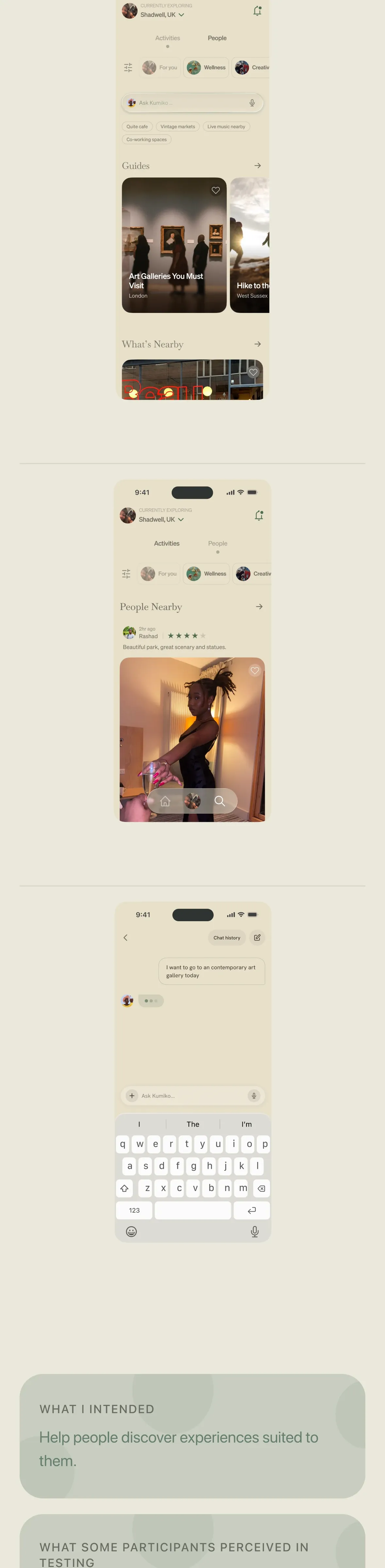
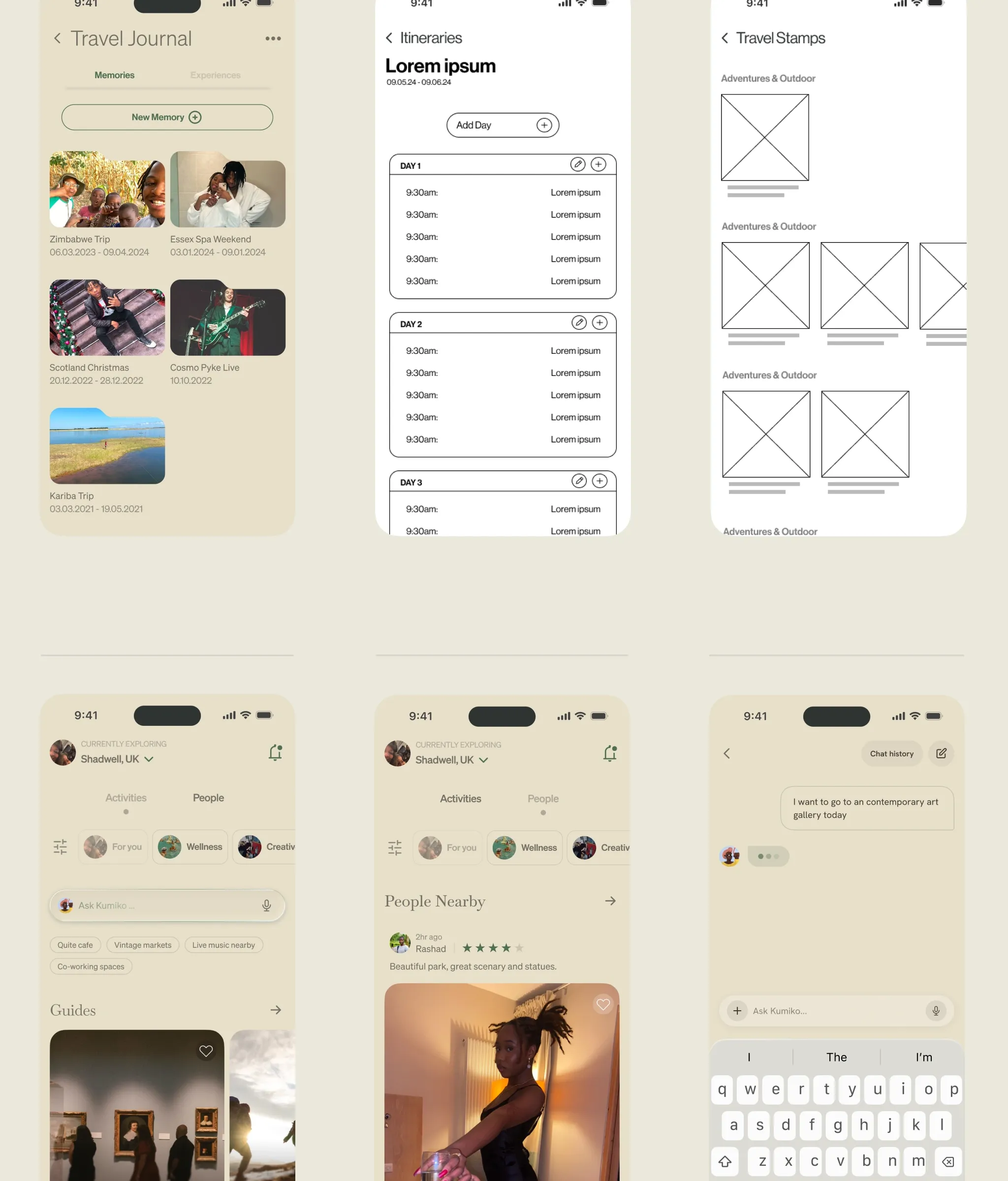
Travel Planning + Documentation
Discovery
Social Content
AI Buddy
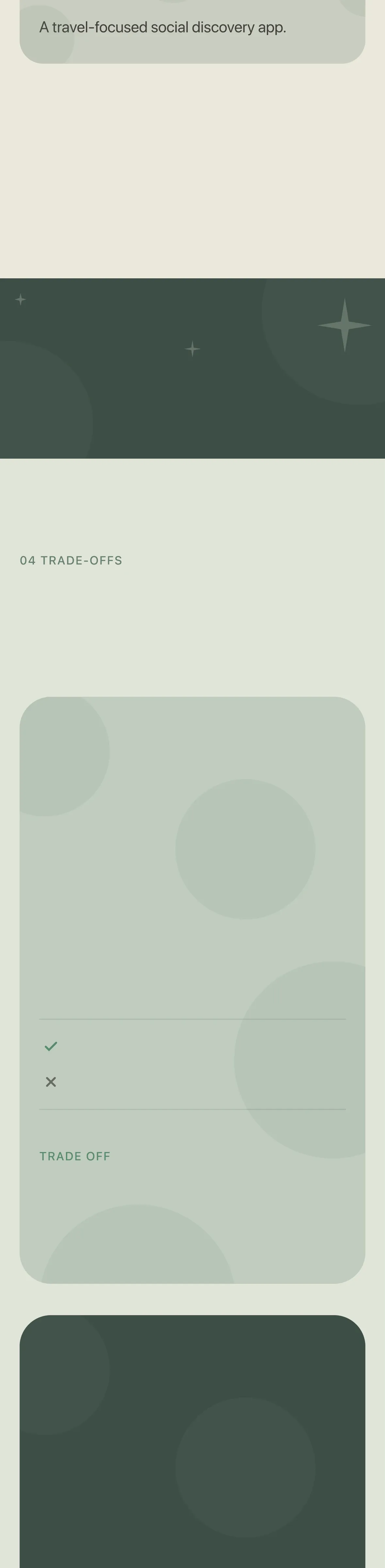
Moderated testing with 6 participants also surfaced the gap:
Travel planning and social elements were shaping the experience more than discovery.
One question set the direction —
How might we help people move from exploring places and events to confidently choosing what to do?
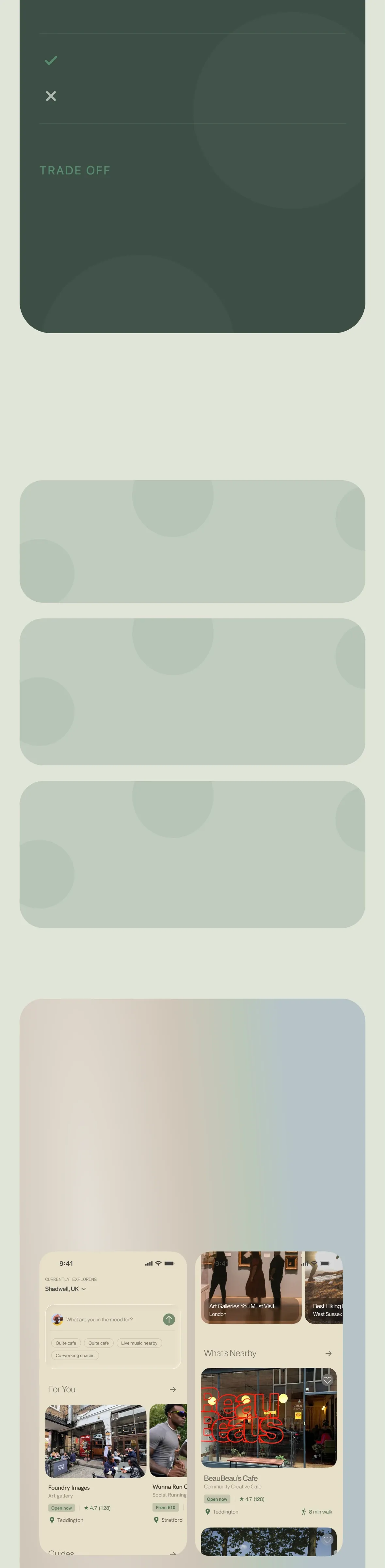
Focus meant deciding which behaviours belonged.
01 / City exploration Not trip management.
I mistook serving travellers for needing trip-planning tools. Focusing on urban dwellers clarified the need locals and visitors shared: Finding somewhere worth going.
Visitors can still discover a new city
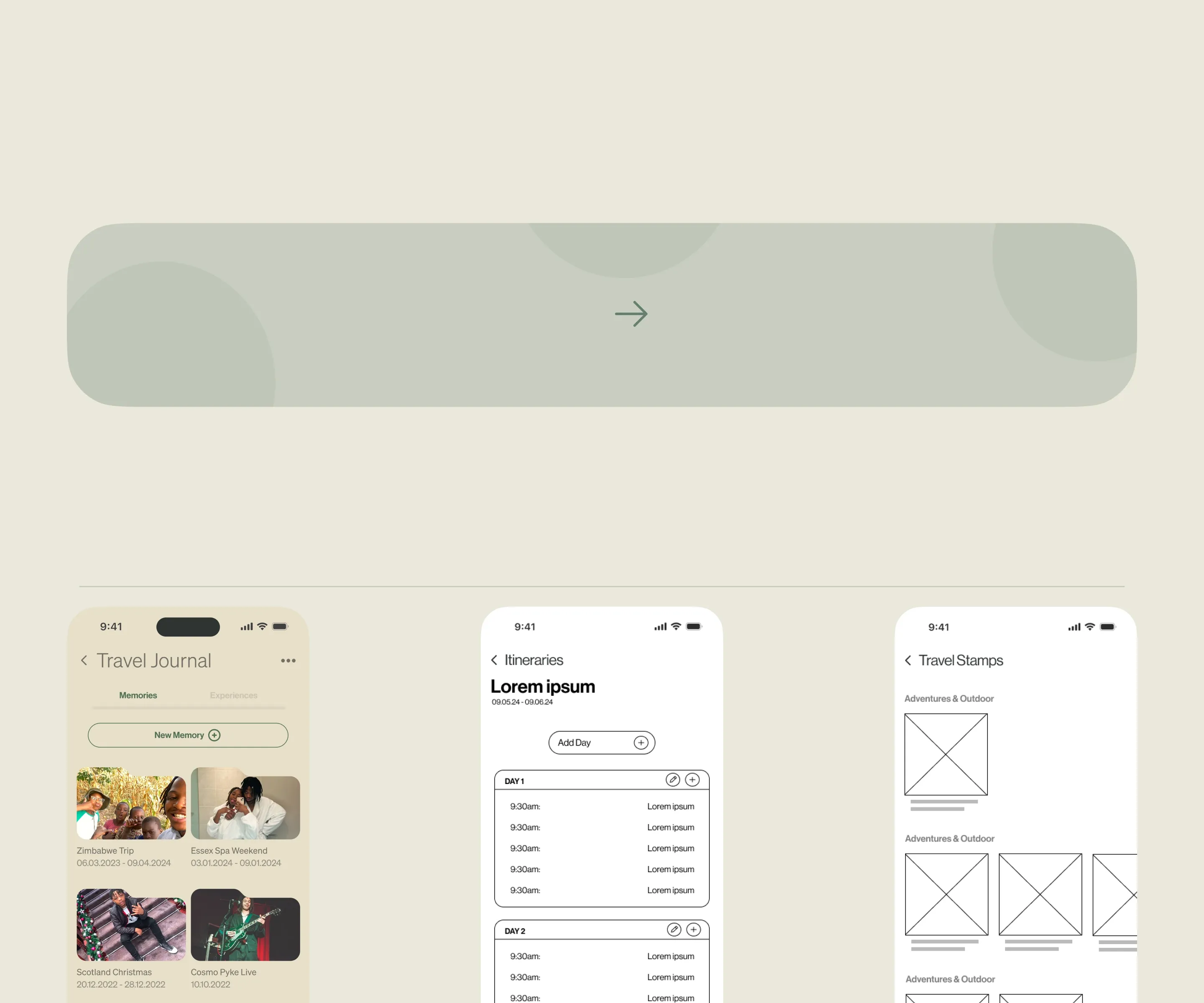
Itineraries, stamps and journals
Less trip-management depth, in exchange for a clearer everyday purpose.
02 / Decision context Not a social destination.
Social features diluted Wander’s purpose. For the MVP, I kept place-based Experiences to help people decide where to go.
Shared Experiences attached to places
Social Feeds, friends and profile browsing
Less friend-led discovery, in exchange for community input focused on the decision.
With the focus clear, I turned the original questions into three system rules.
Context
Learned taste should be filtered through current time, location and intent.
Behaviour
Signals should be weighted by intent, from passive attention to deliberate choice and real-world action.
Confidence
Knowing why something fits, what it involves and how to act on it builds confidence to choose.
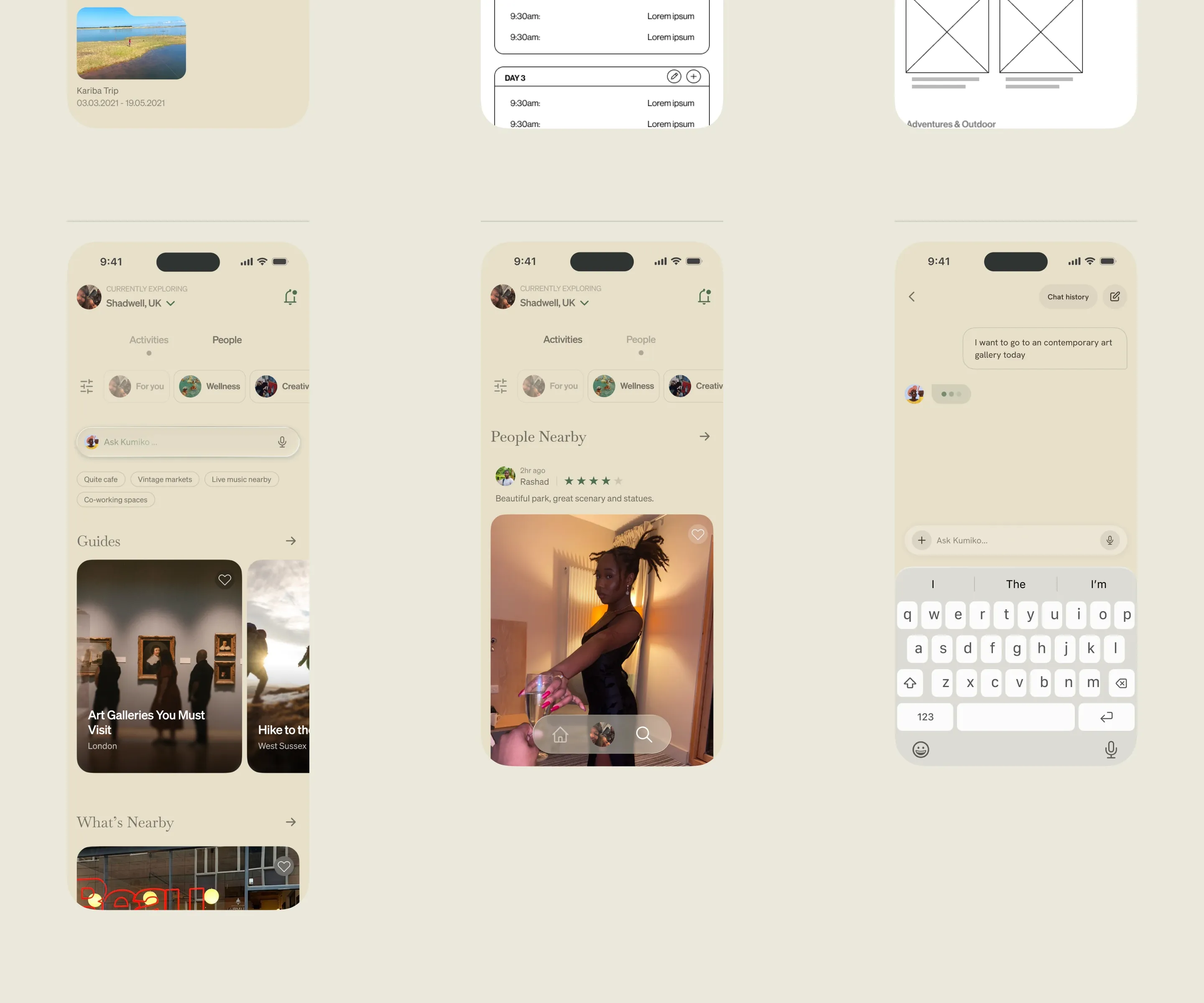
With the scope narrowed, Home had to find its purpose.
INITIAL TEST 1
Personalisation felt secondary
Home reflected location more than the person, undermining personalised exploration.
INITIAL TEST 2
Personalisation began shaping Home
Context and user actions began shaping what appeared, laying the foundations for personalisation, but the routes remained disconnected.
05 BREAKTHROUGH - WANDER
The product needed one connected learning system to support confident decisions.
Recommended
Named the output
DSCVR
Named the activity
Wander
Named the evolving journey
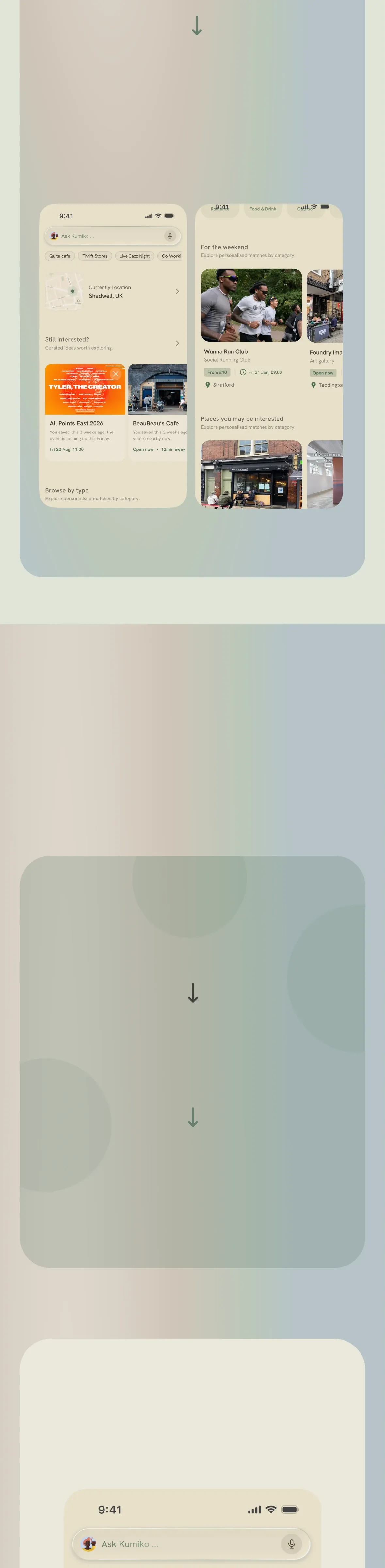
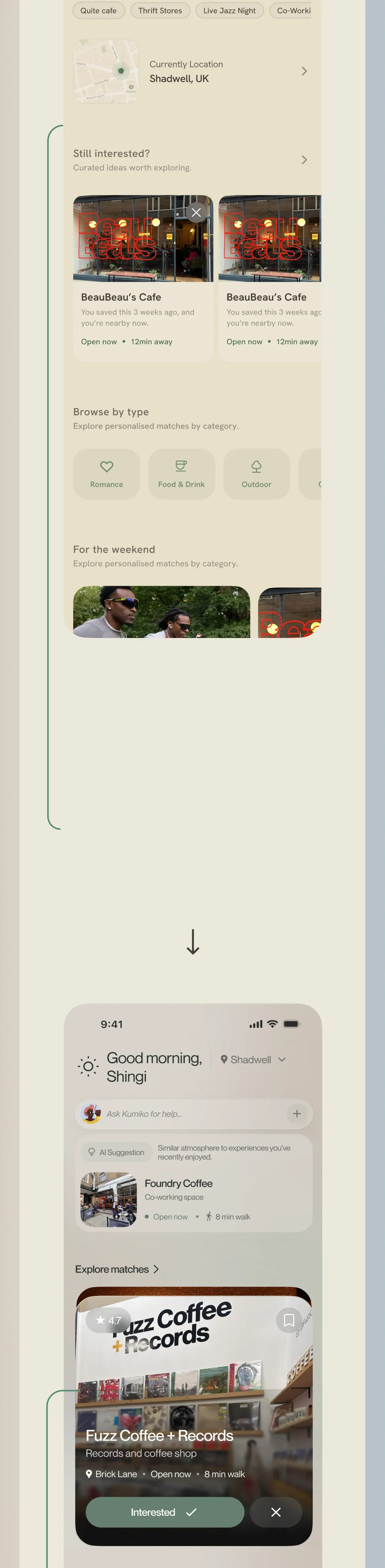
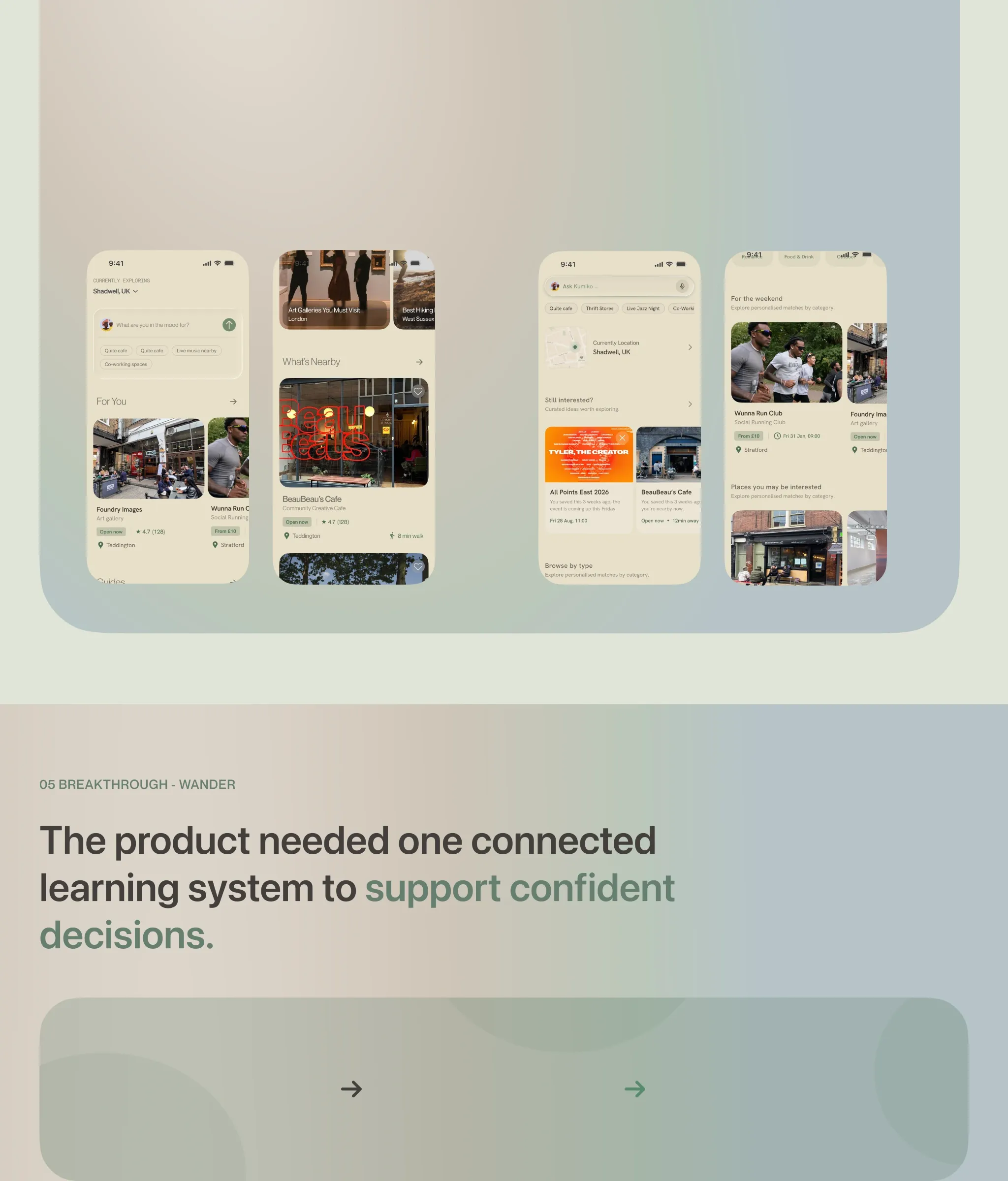
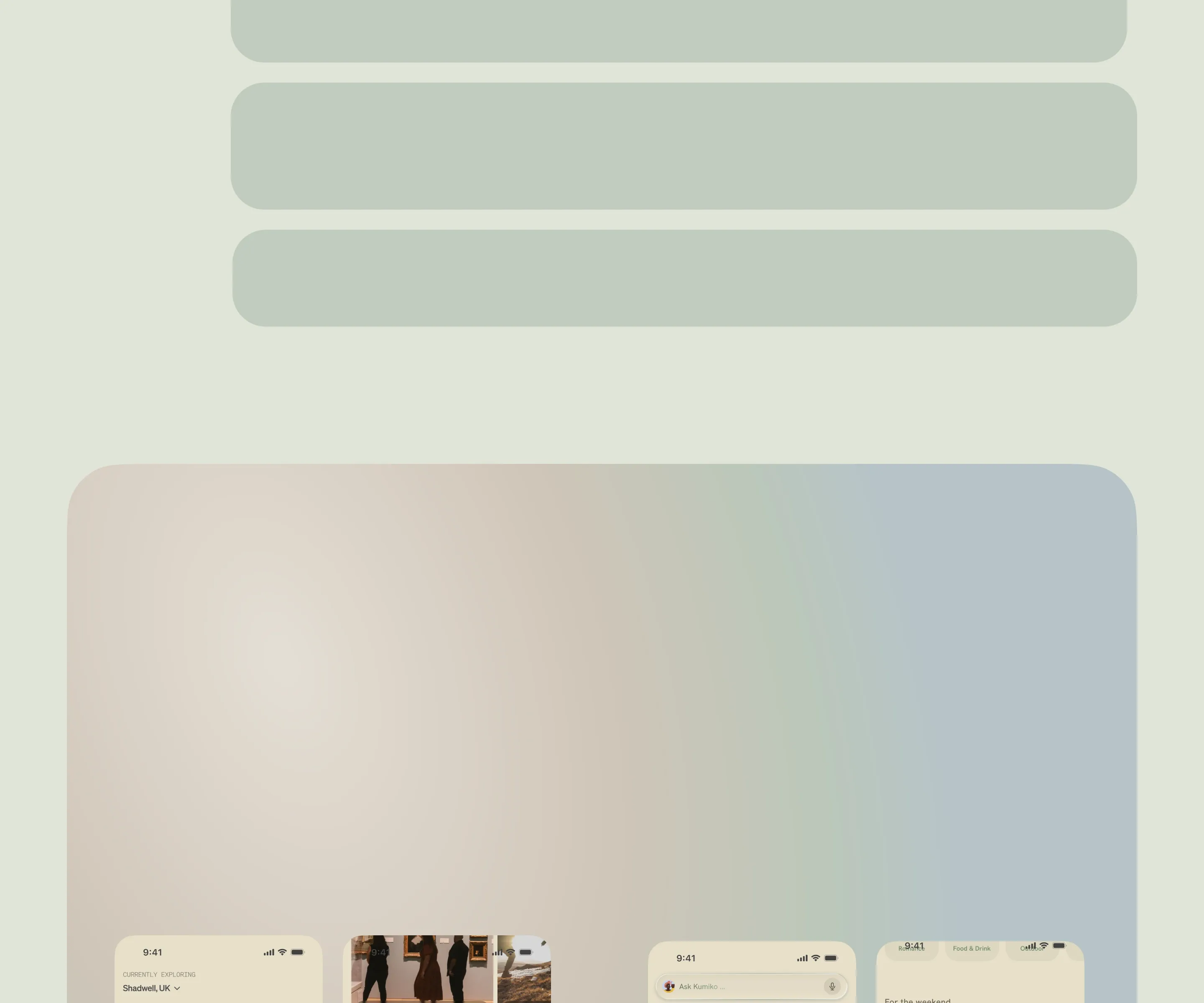
The new direction needed a visual language to match.
DSCVR
Monochromatic palette, flatter hierarchy, beige interface.
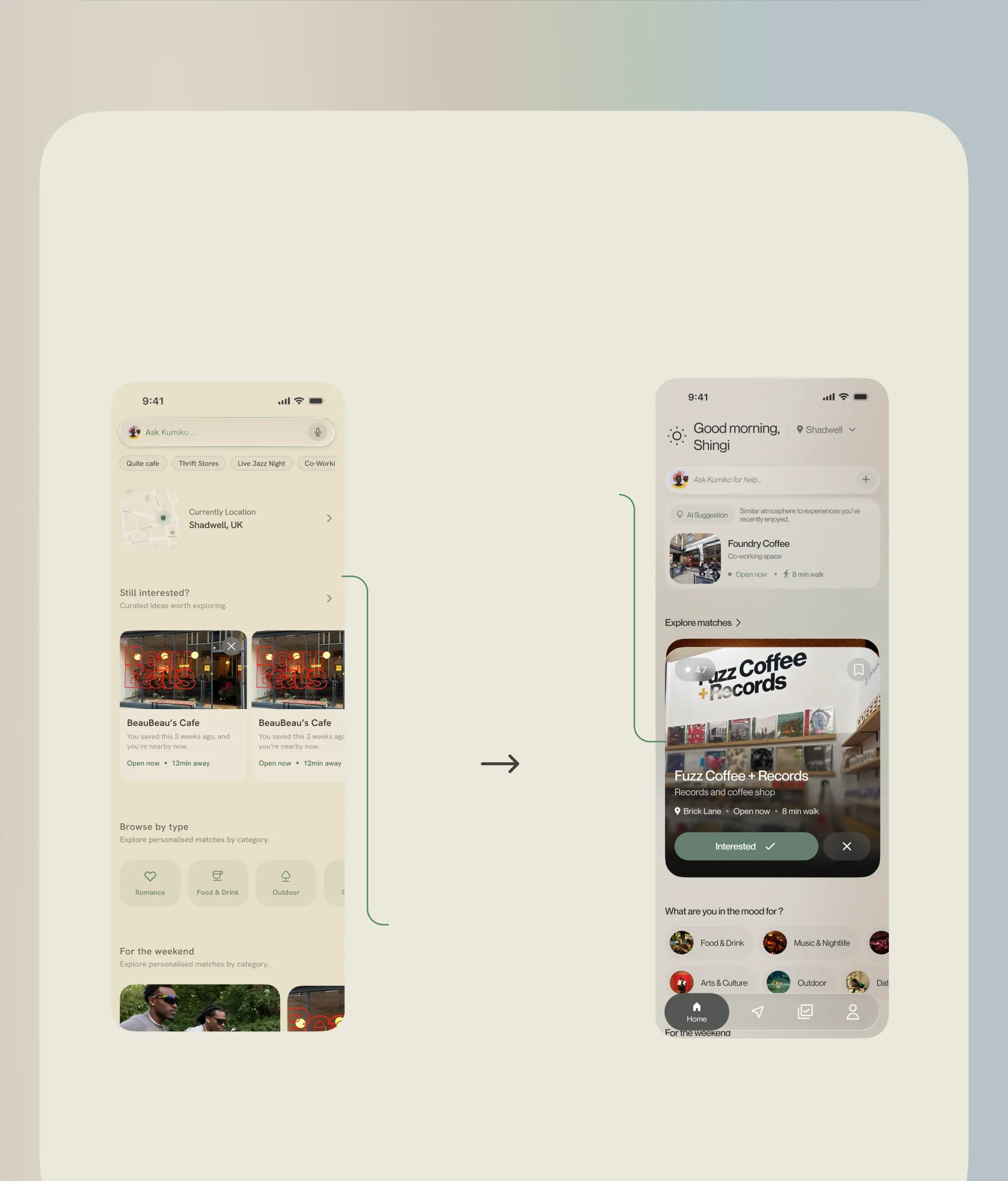
Home’s hierarchy and layout were refined to fit the new direction.
Wander
Airy atmospheric gradient, clearer visual focus.
Matches were also introduced as another learning route for the system.
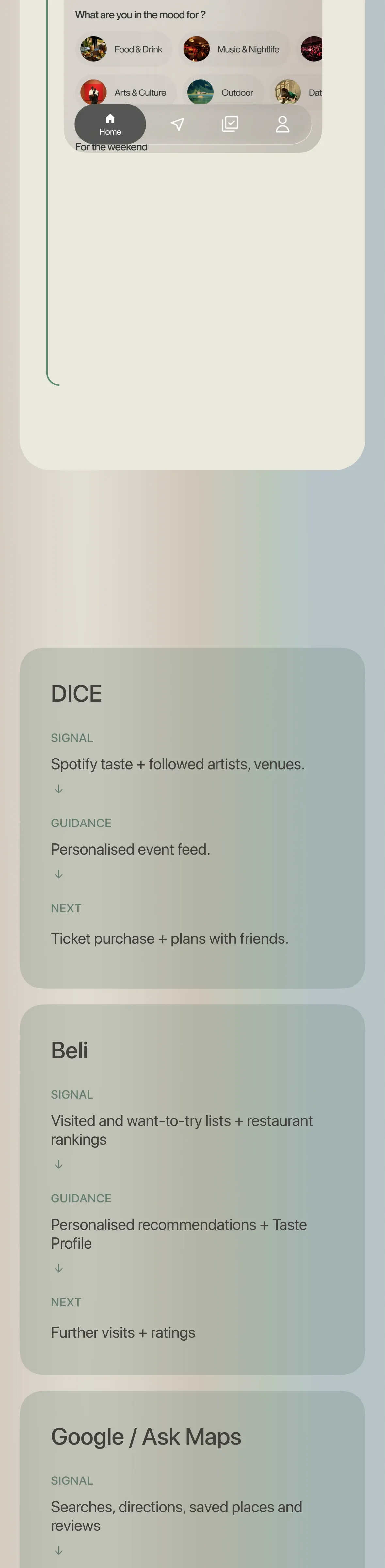
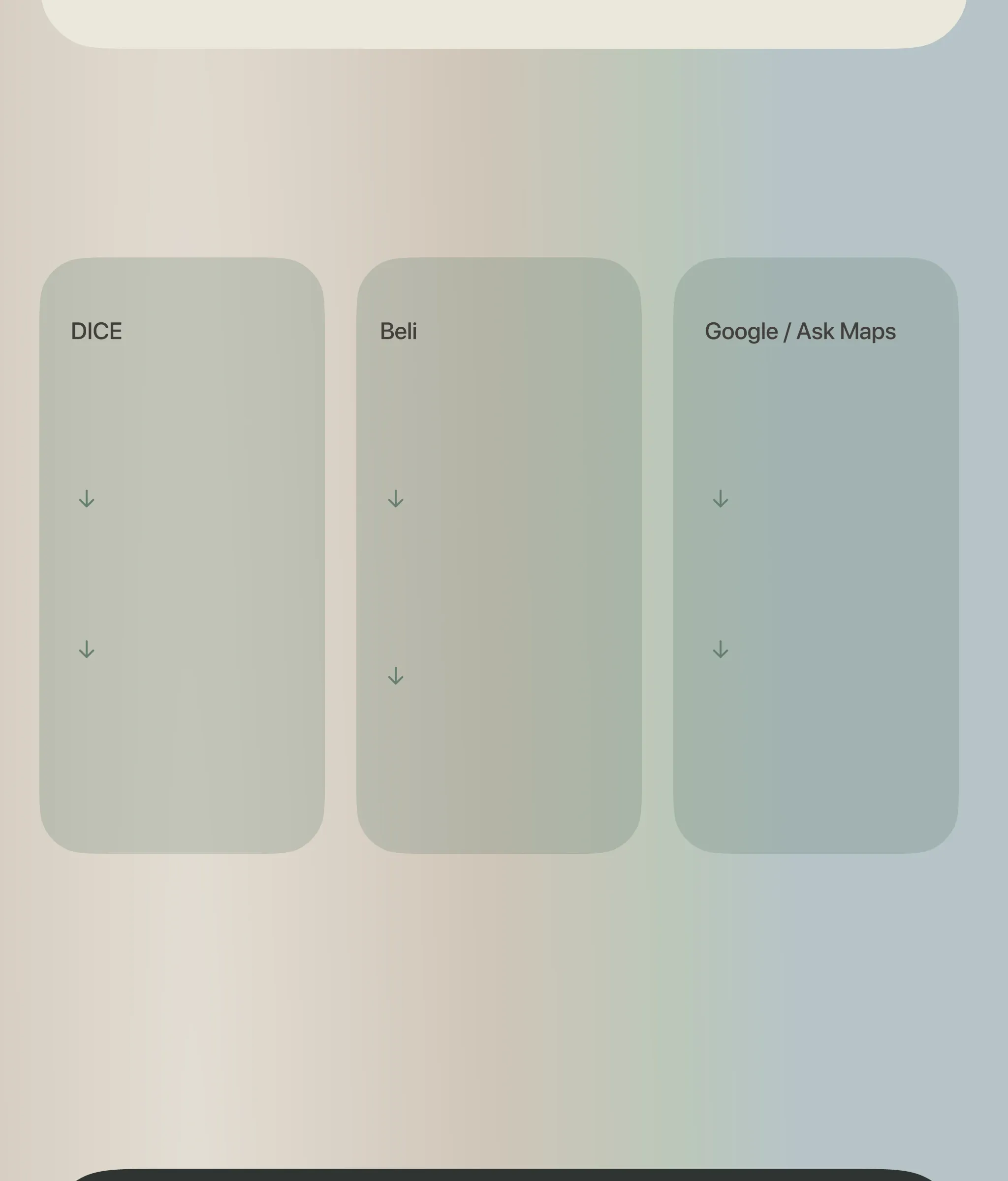
I compared how competitors moved from user signal to decision guidance to next action:
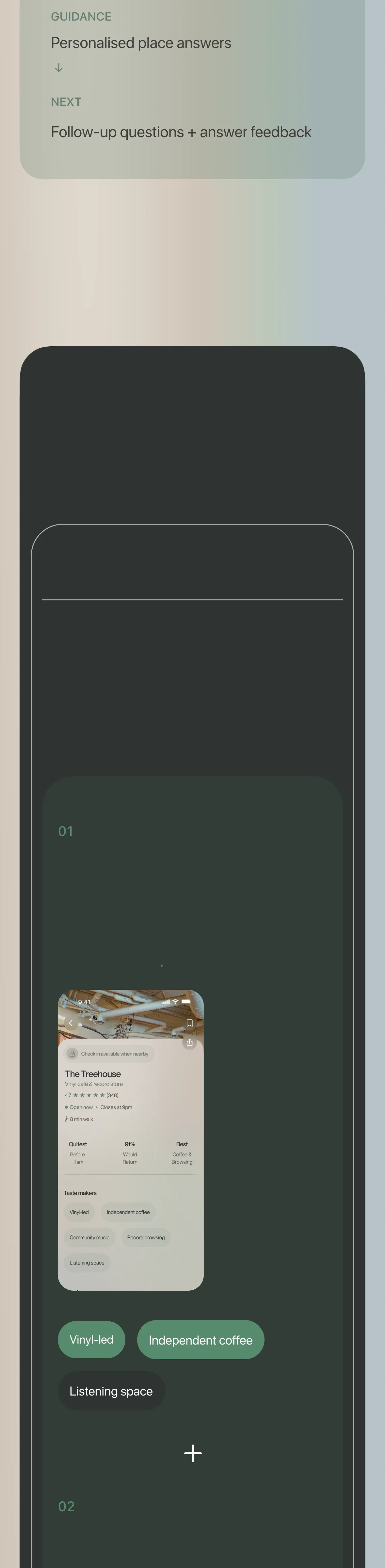
Learned taste + current context → guidance on what to do next
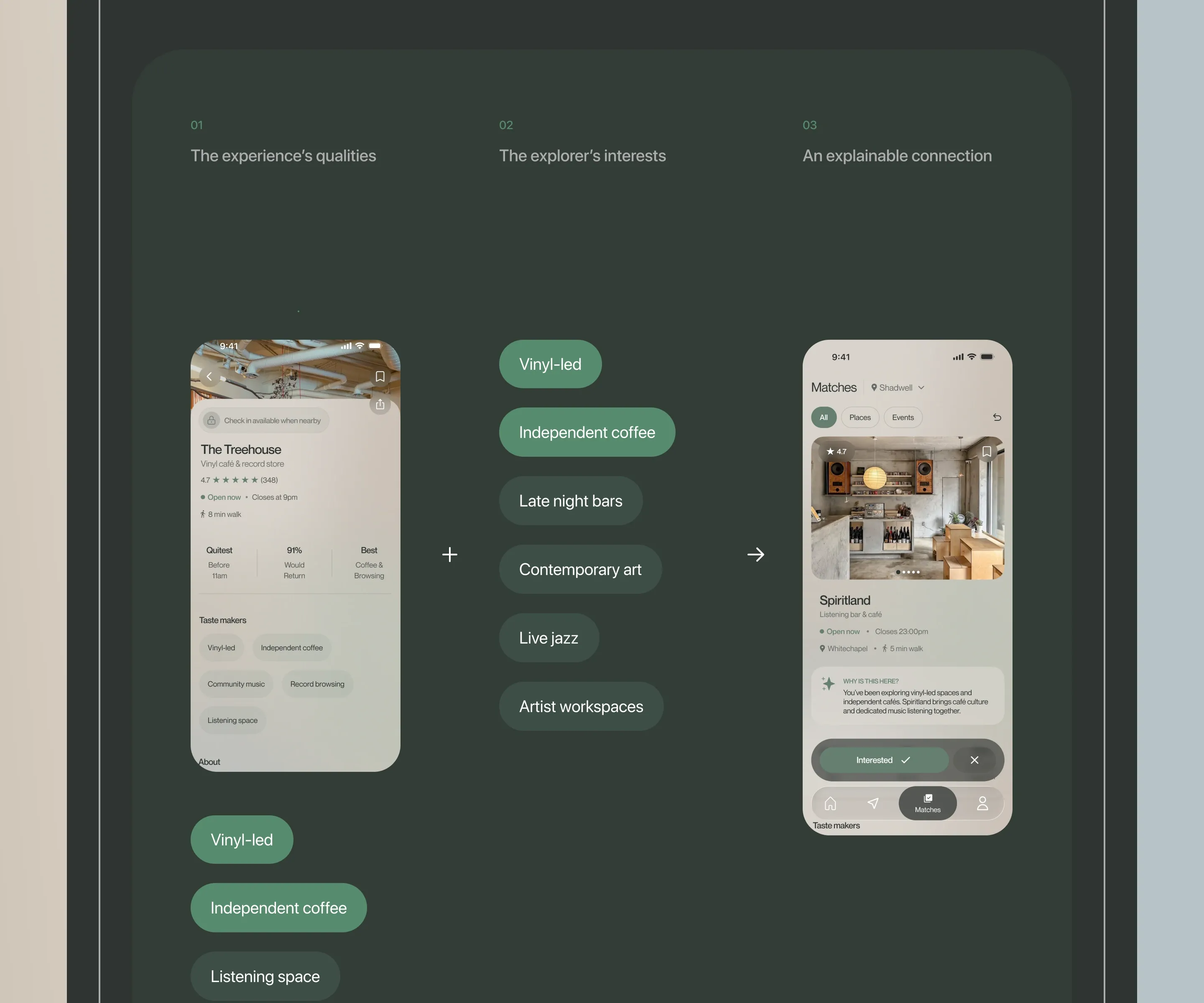
To build one understanding across the product, users, places and events needed a shared vocabulary.
Shared language
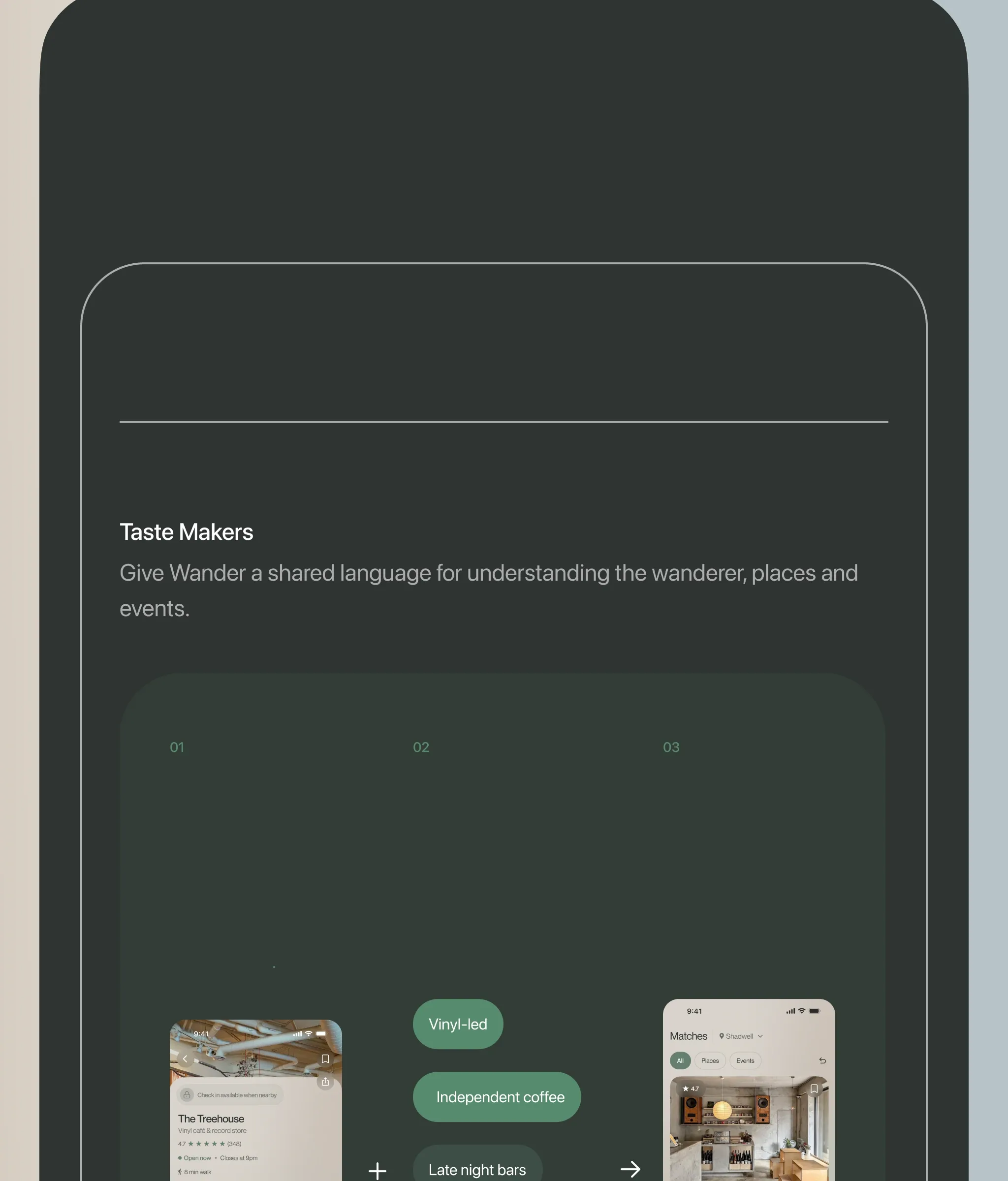
Taste Makers
Give Wander a shared language for understanding the wanderer, places and events.
The experience’s qualities
Taste Makers describe specific qualities beyond a broad category.
THE TREEHOUSE
FOOD & DRINK
The explorer’s interests
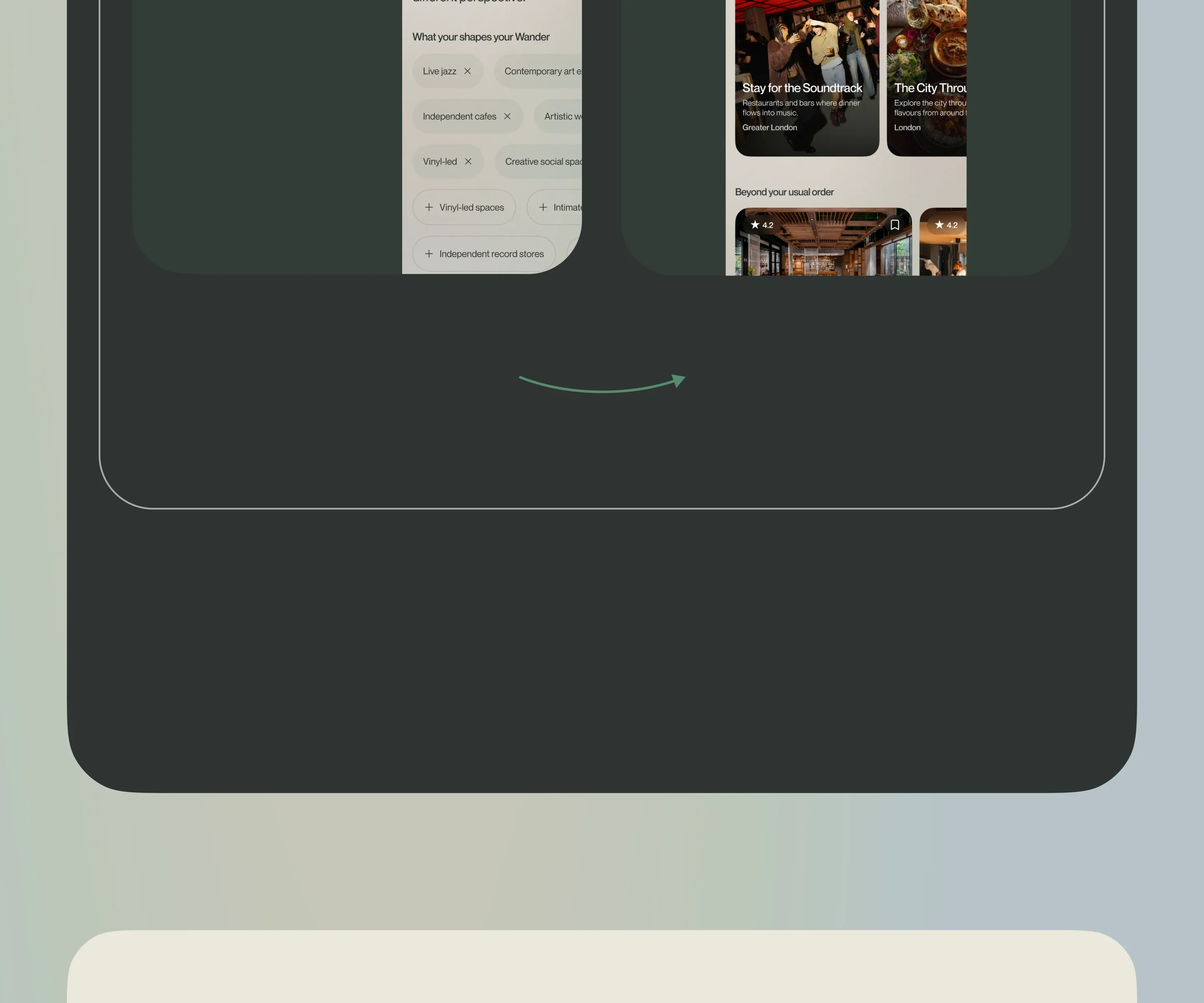
The same language describes what someone is drawn to.
YOUR TASTE
The same vocabulary makes the connection between person and experience specific.
An explainable connection
Shared qualities help explain why an experience could suit someone.
MATCHES
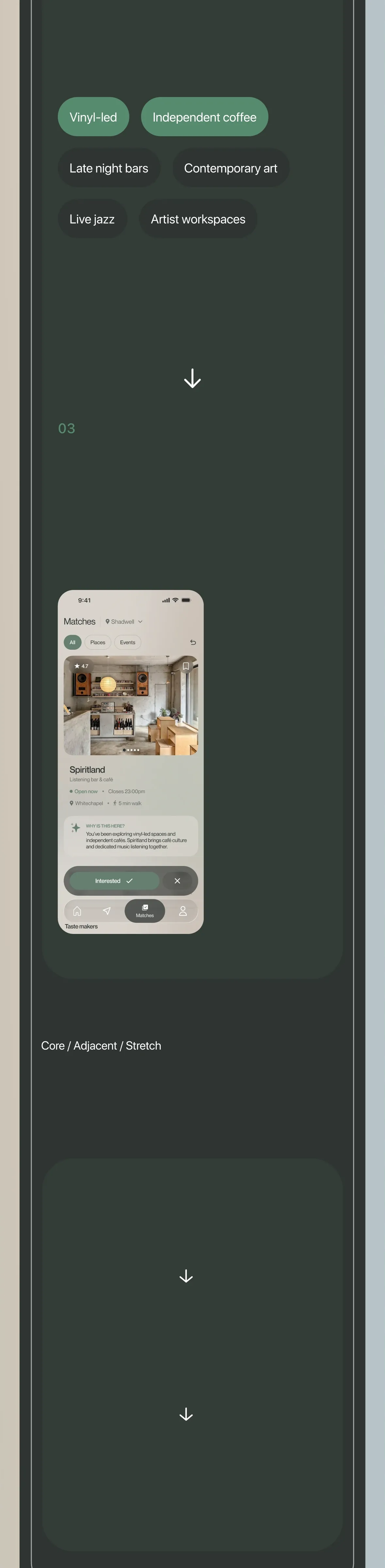
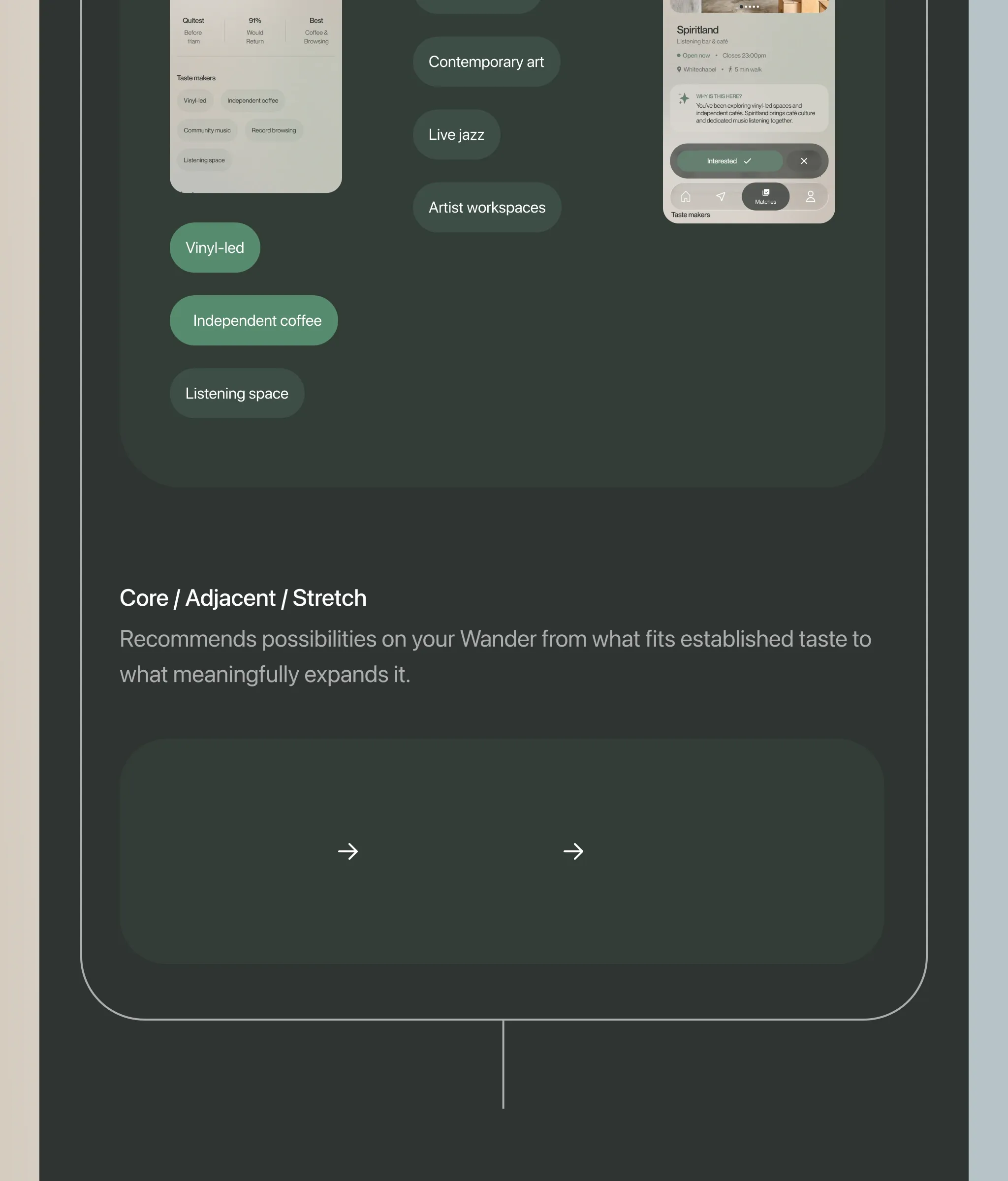
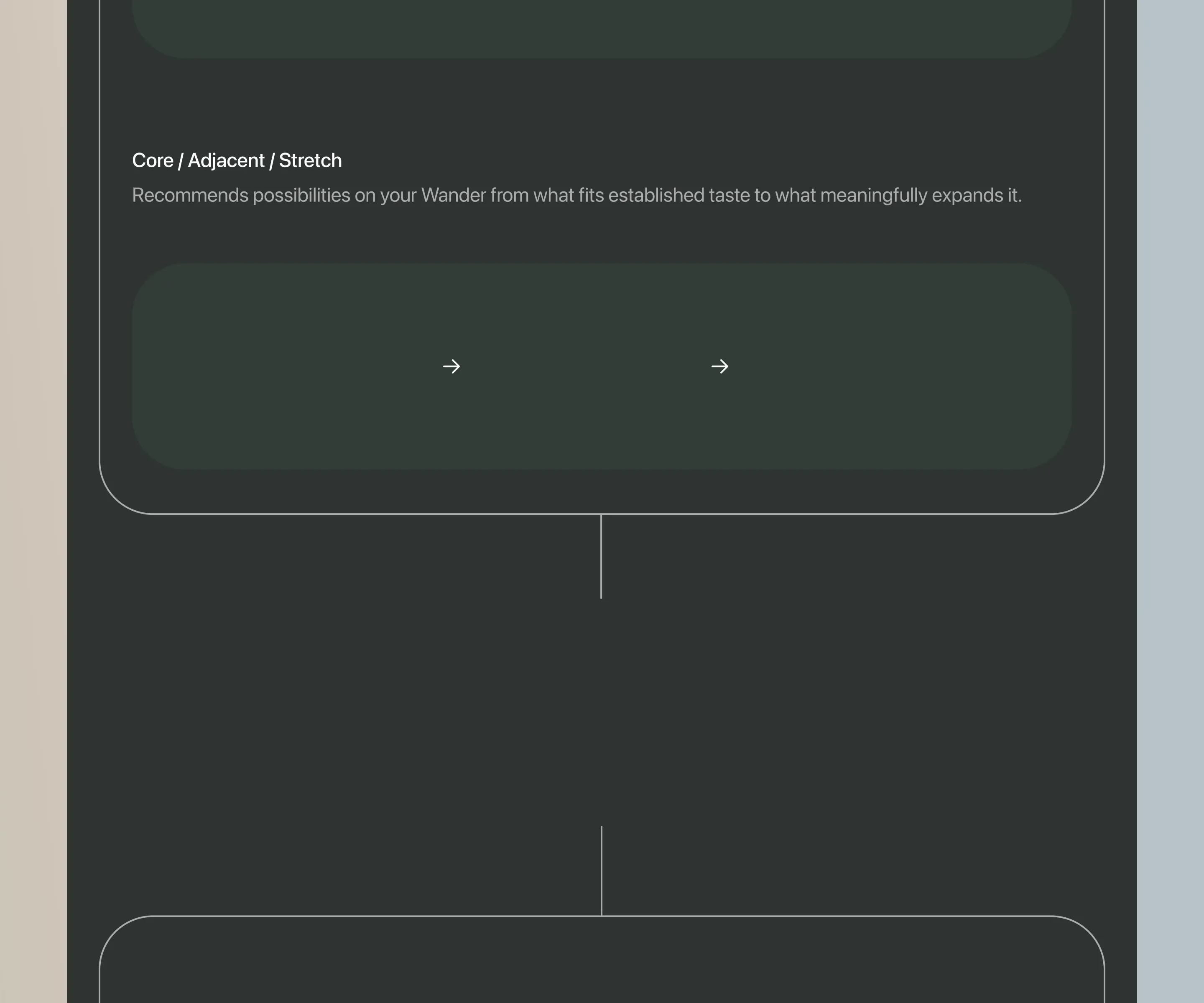
Recommends possibilities on your Wander from what fits established taste to what meaningfully expands it.
Core
Possibilities aligned with established taste.
Adjacent
Extends familiar interests into something new
Stretch
Moves beyond established taste while keeping a meaningful connection
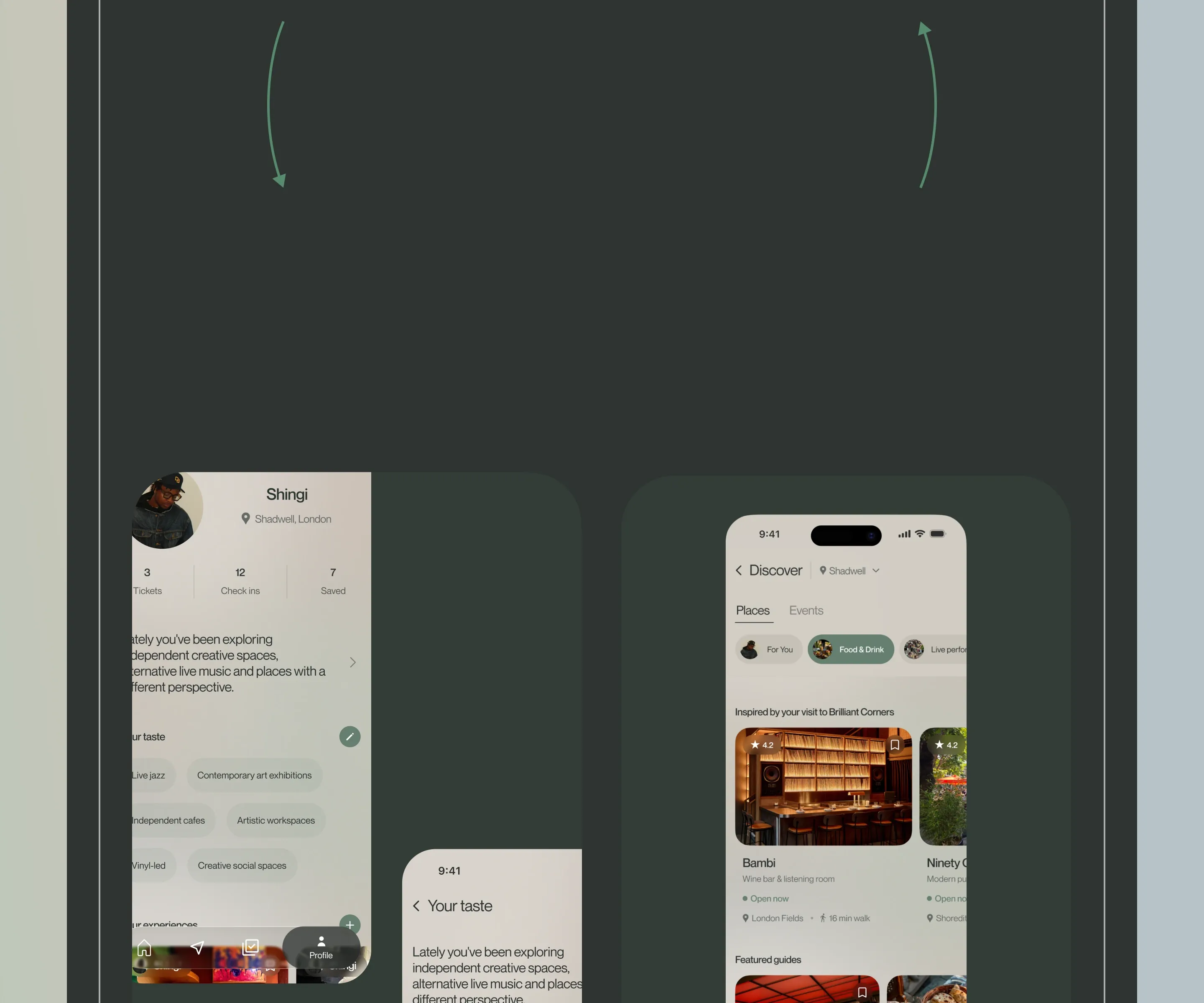
That shared vocabulary connected signals from every route, powering a loop that could learn, reflect and guide.
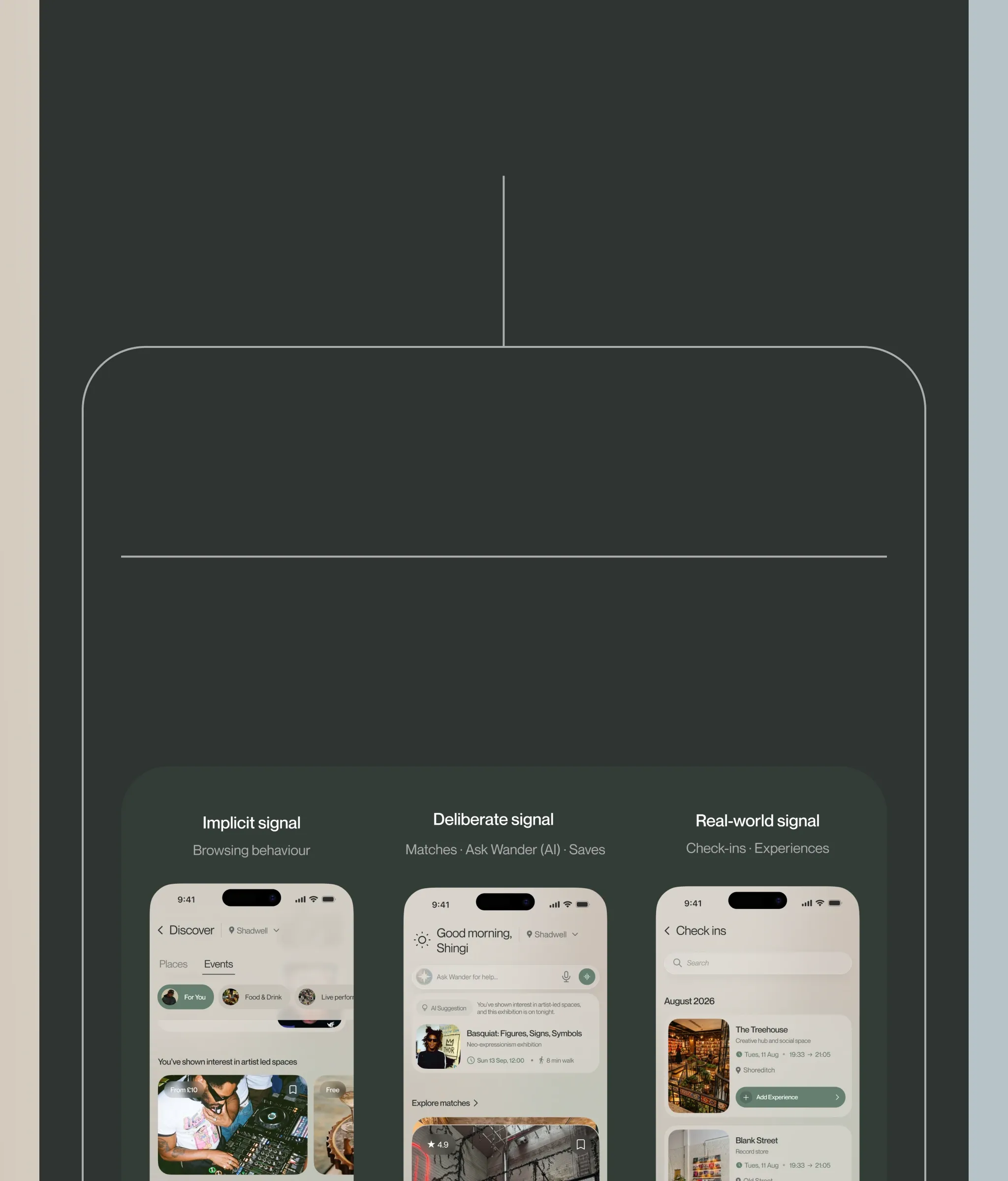
Connected learning loop
01
Learn
Browsing, matches, check-ins, saves and AI conversations signal what someone gravitates towards.
Implicit signal
Browsing behaviour
Deliberate signal
Matches · Ask Wander (AI) · Saves
Real-world signal
Check-ins · Experiences
02
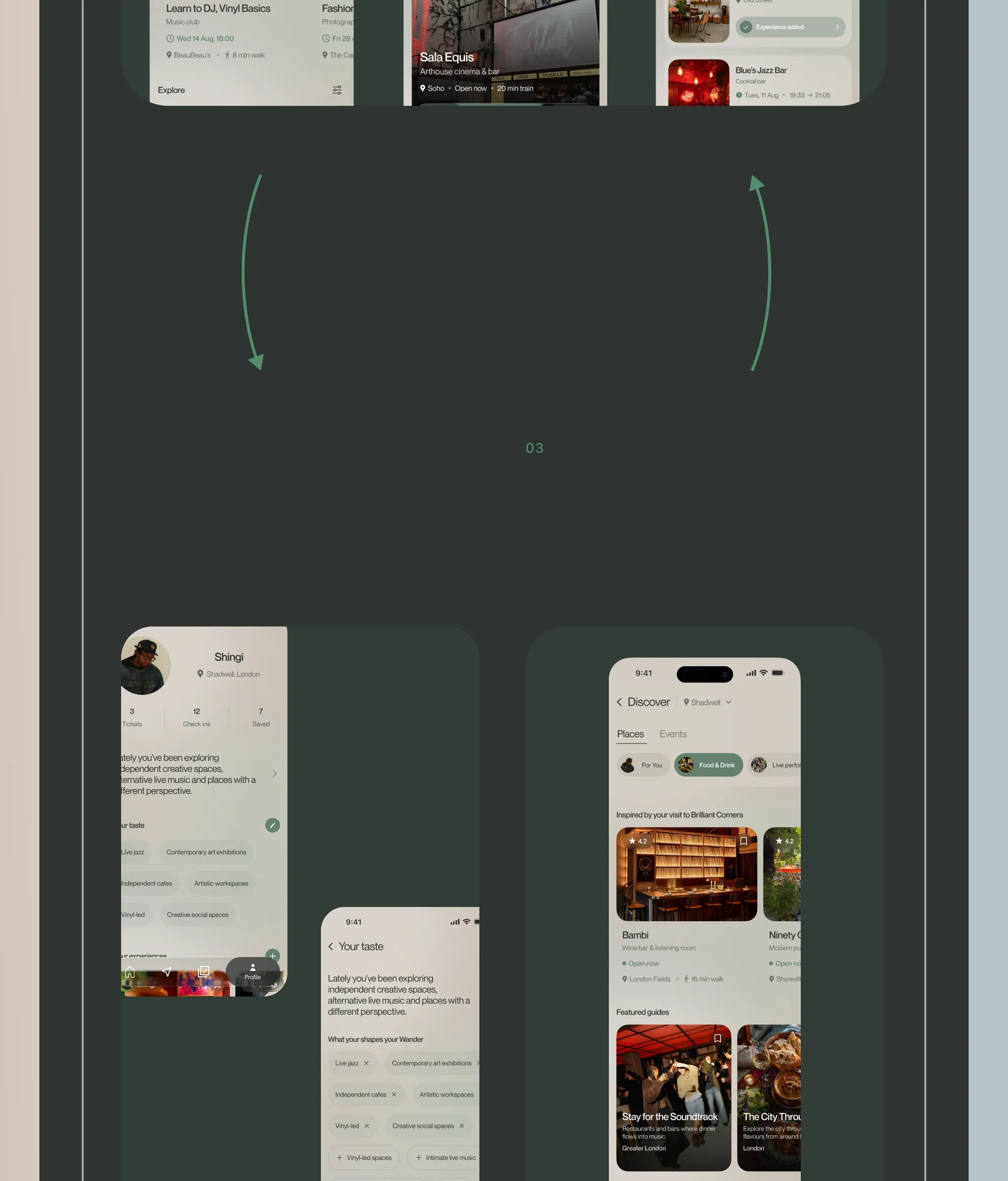
Reflect
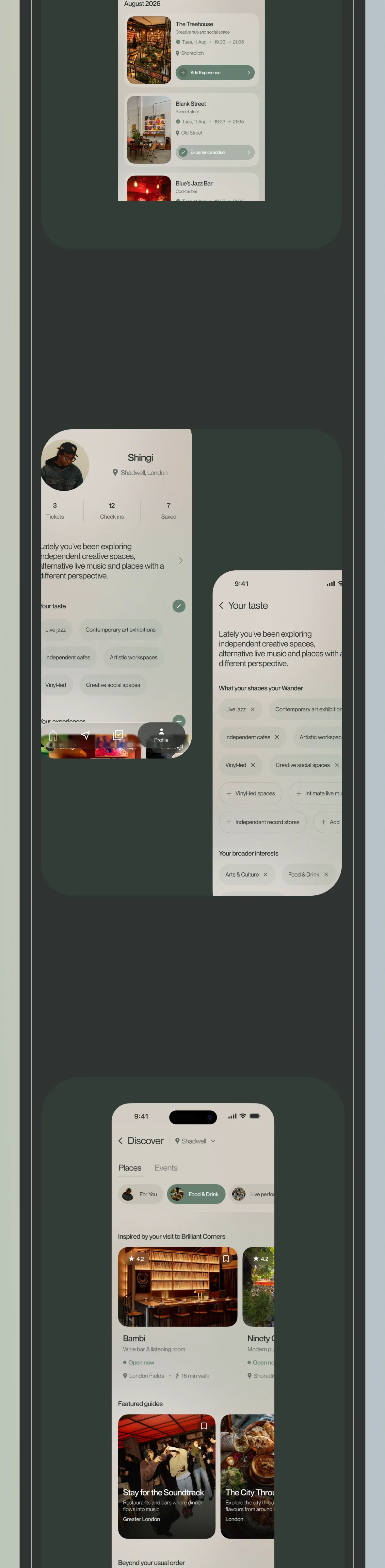
The Explorer Profile makes Wander’s understanding visible and editable.
03
Guide
Wander combines that understanding with context to surface Core, Adjacent and Stretch possibilities.
Together, the shared language and learning loop made the product’s understanding specific, visible and correctable able to explain why something fit, guide a decision and shape what appeared next.
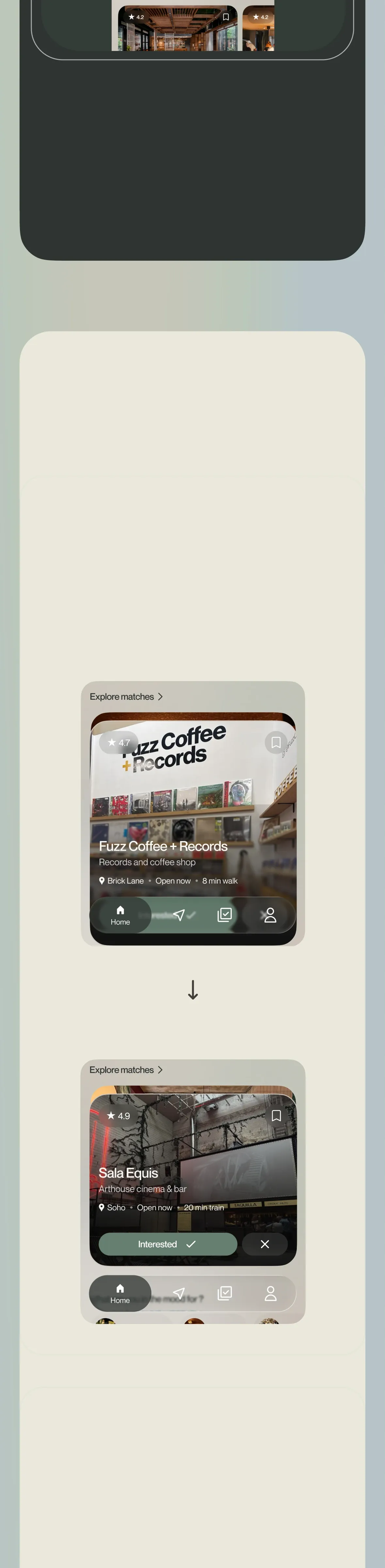
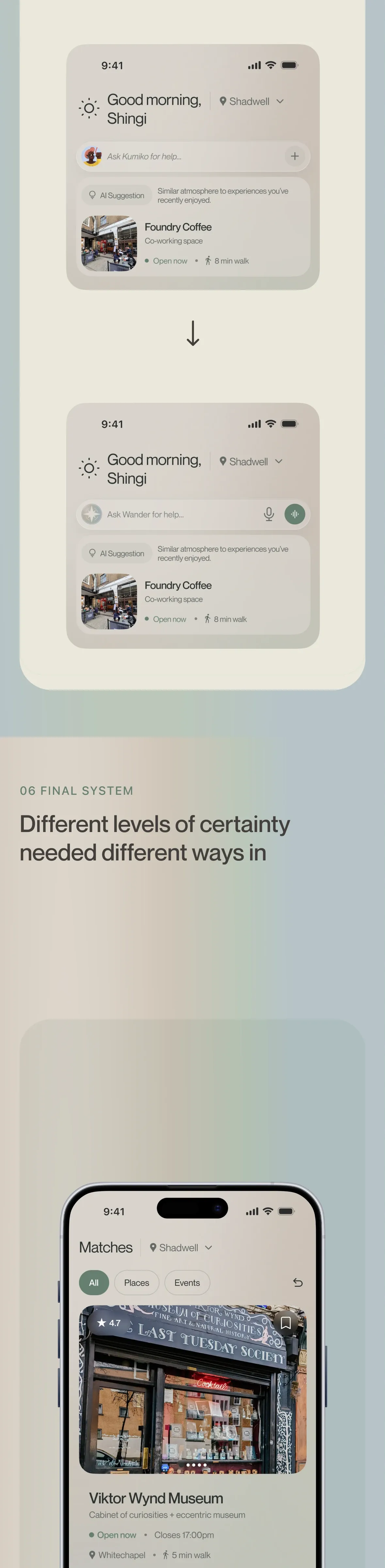
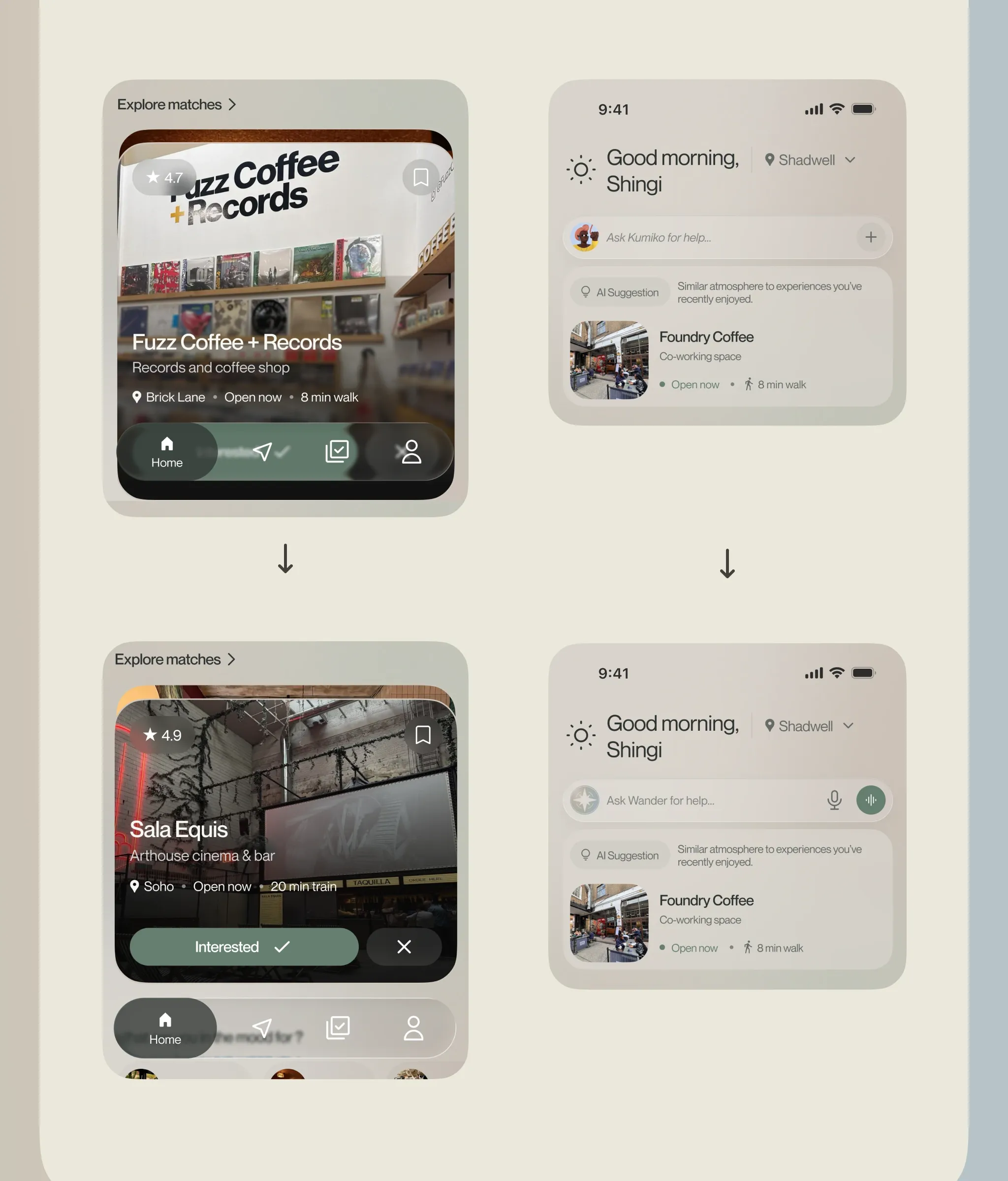
Two final iterations refined Home.
Feedback visible on arrival.
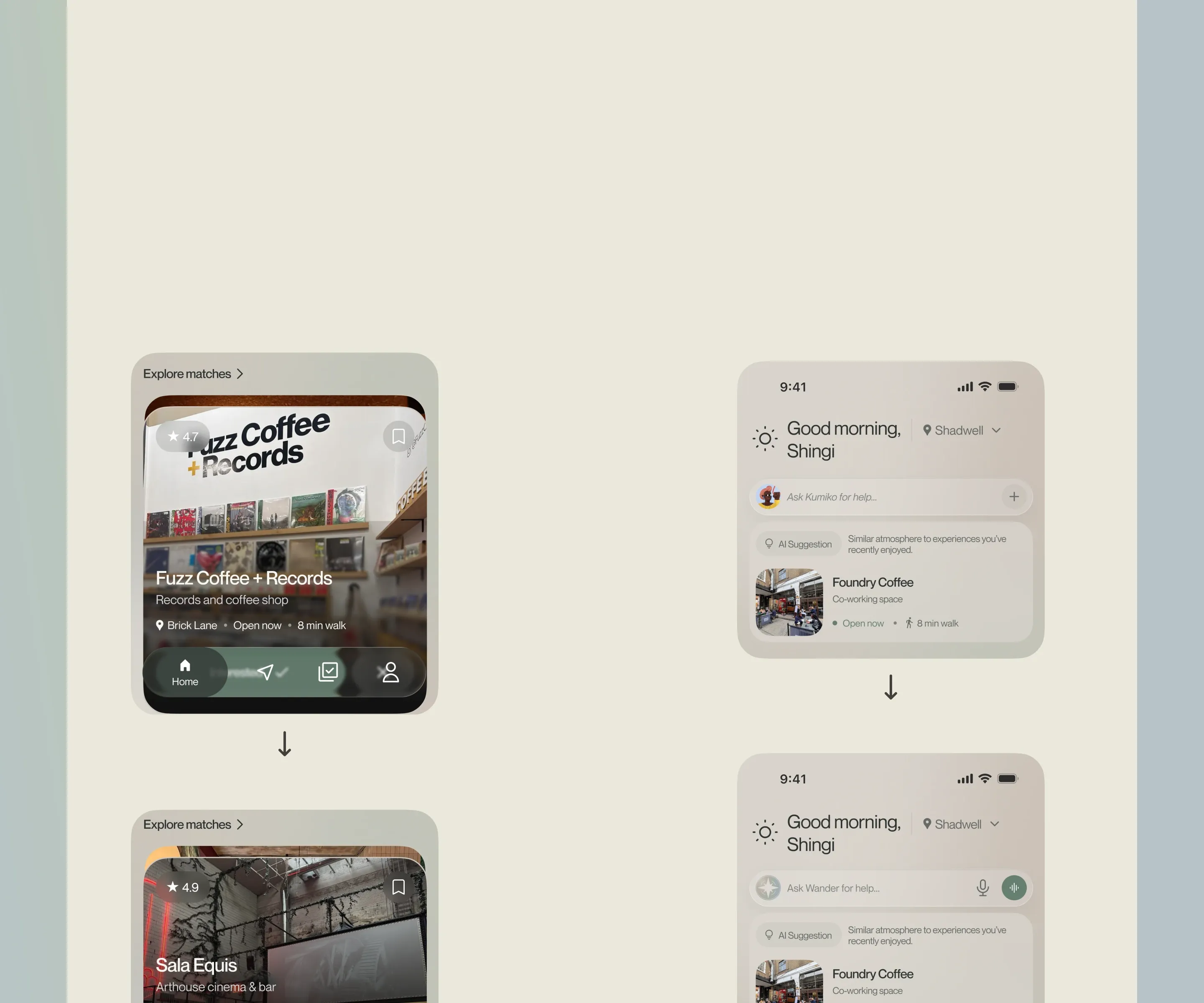
Keeping Interested and × visible on arrival made Matches feel central and immediately actionable.
INITIAL DIRECTION
FINAL ITERATION
Ask Wander, not AI Buddy.
AI Buddy became Ask Wander, turning a generic assistant into a branded conversation between Wander and the wanderer.
INITIAL DIRECTION
FINAL ITERATION
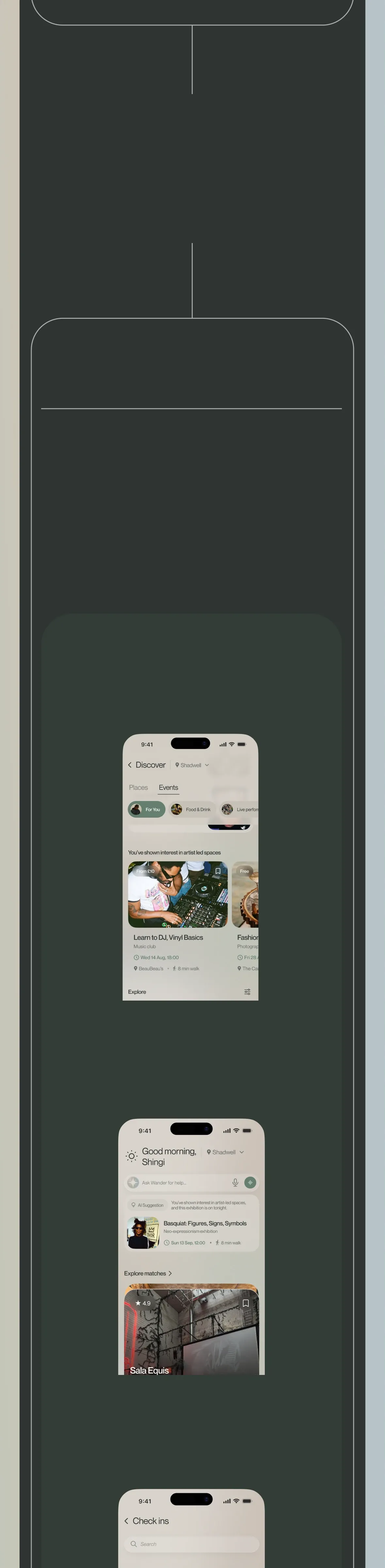
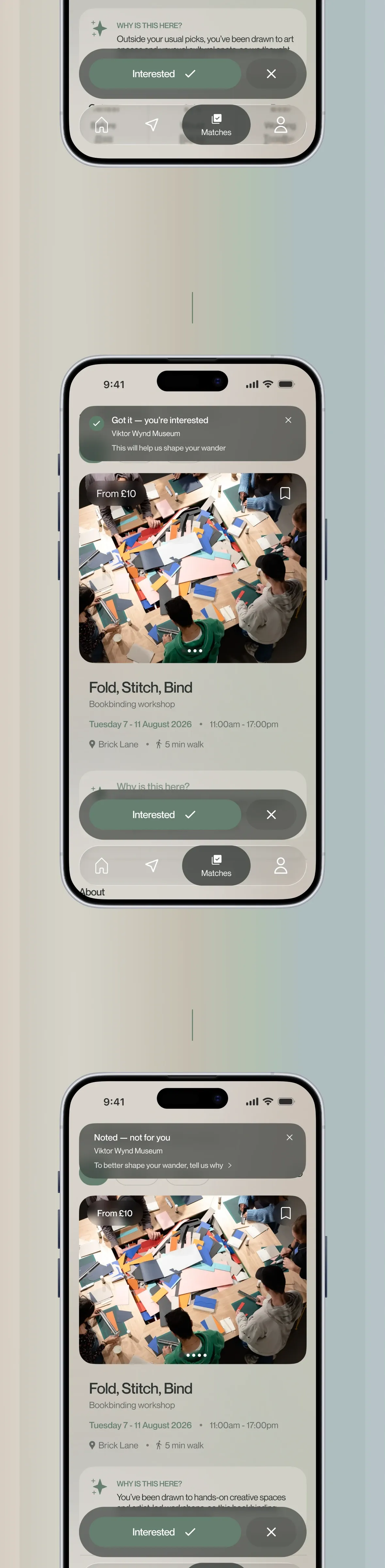
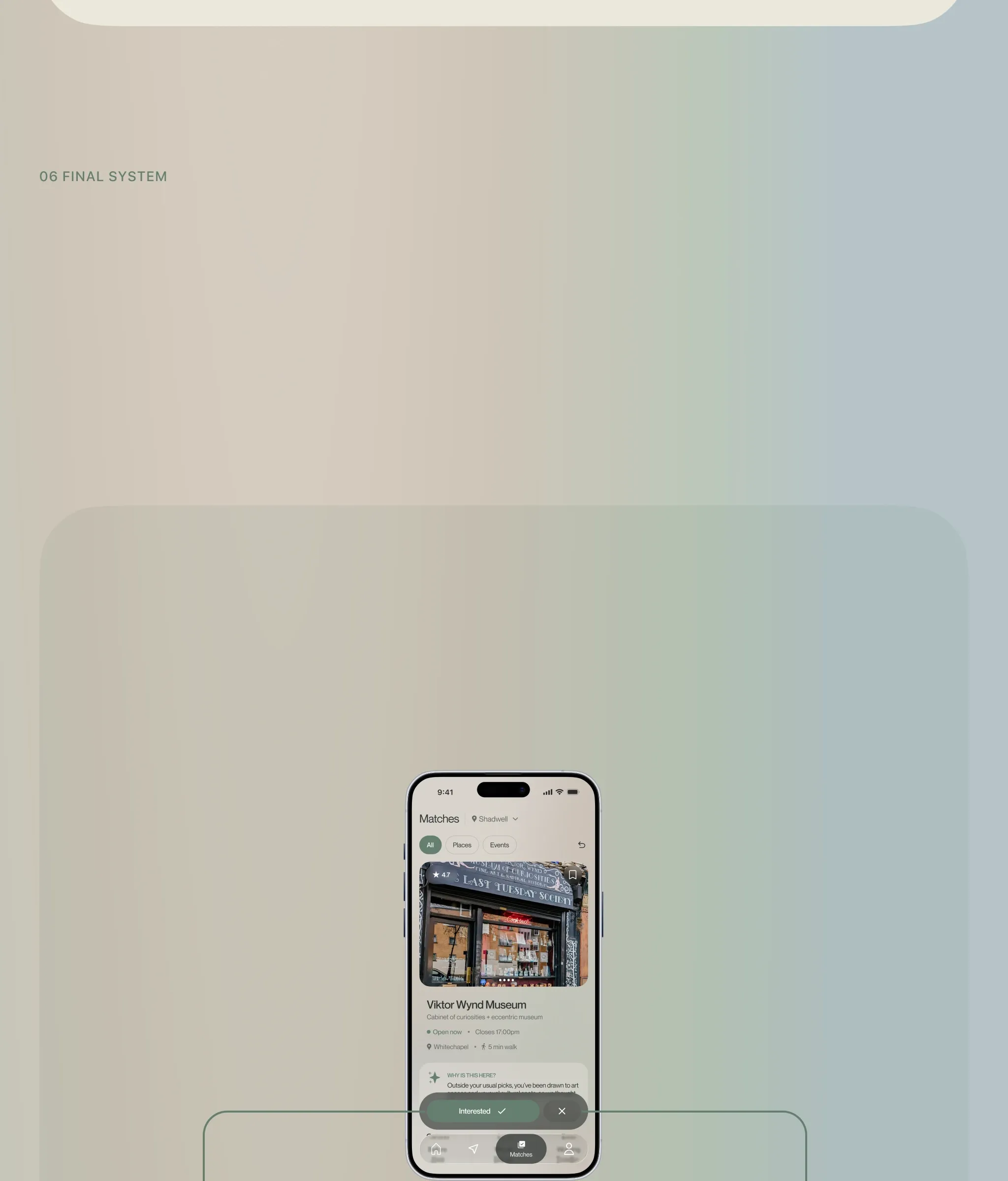
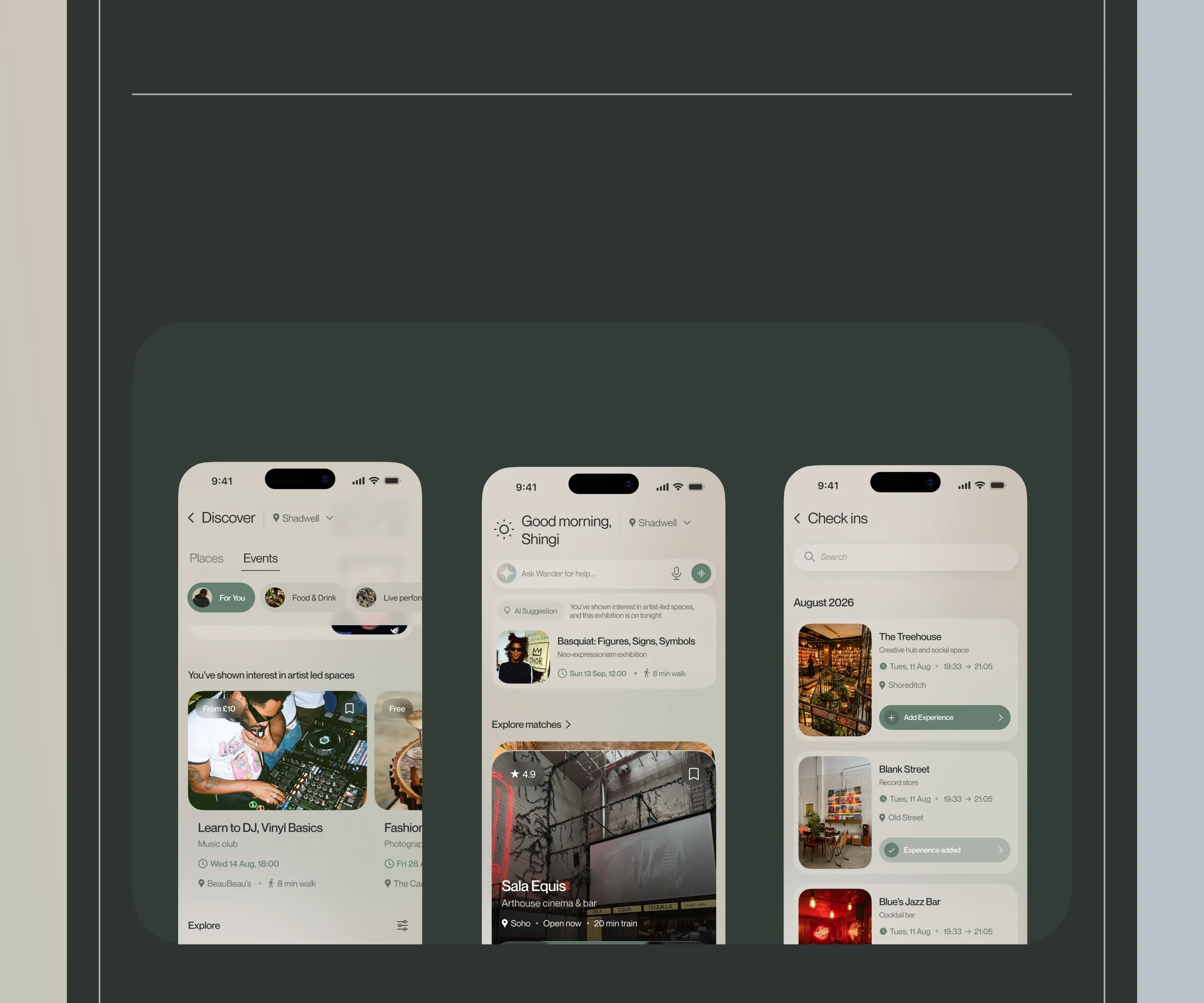
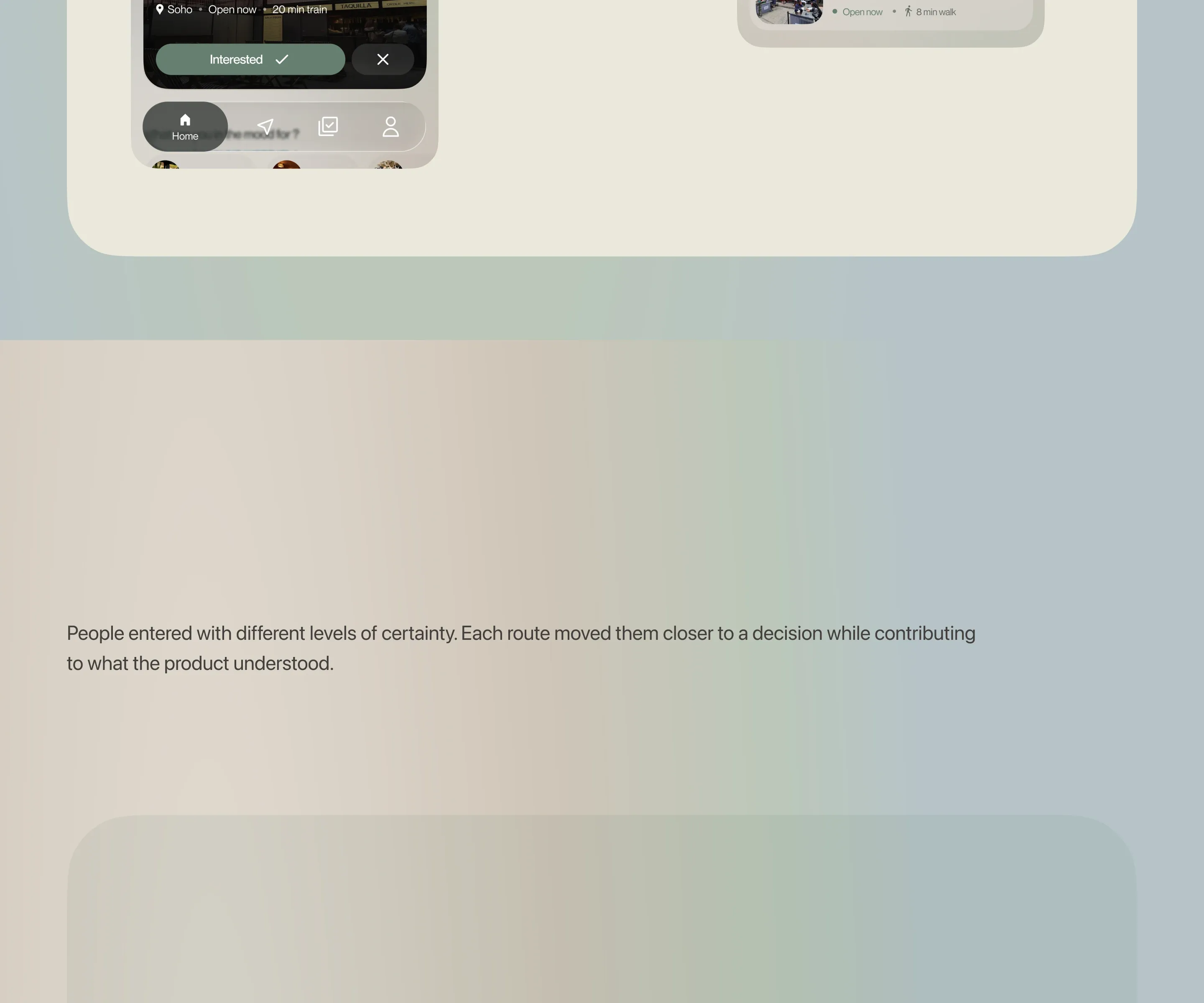
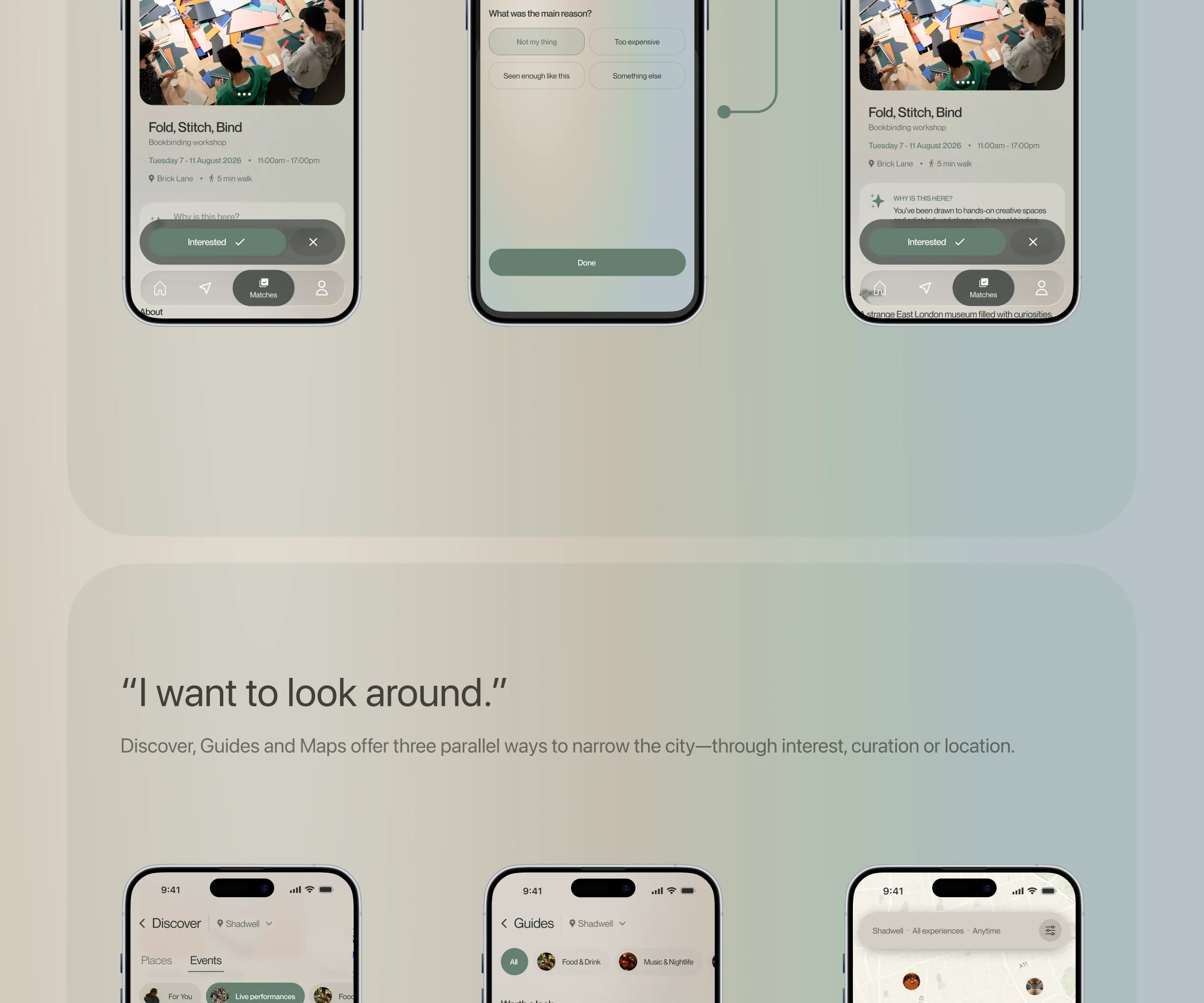
People entered with different levels of certainty. Each route moved them closer to a decision while contributing to what the product understood.
“Show me something I might like”
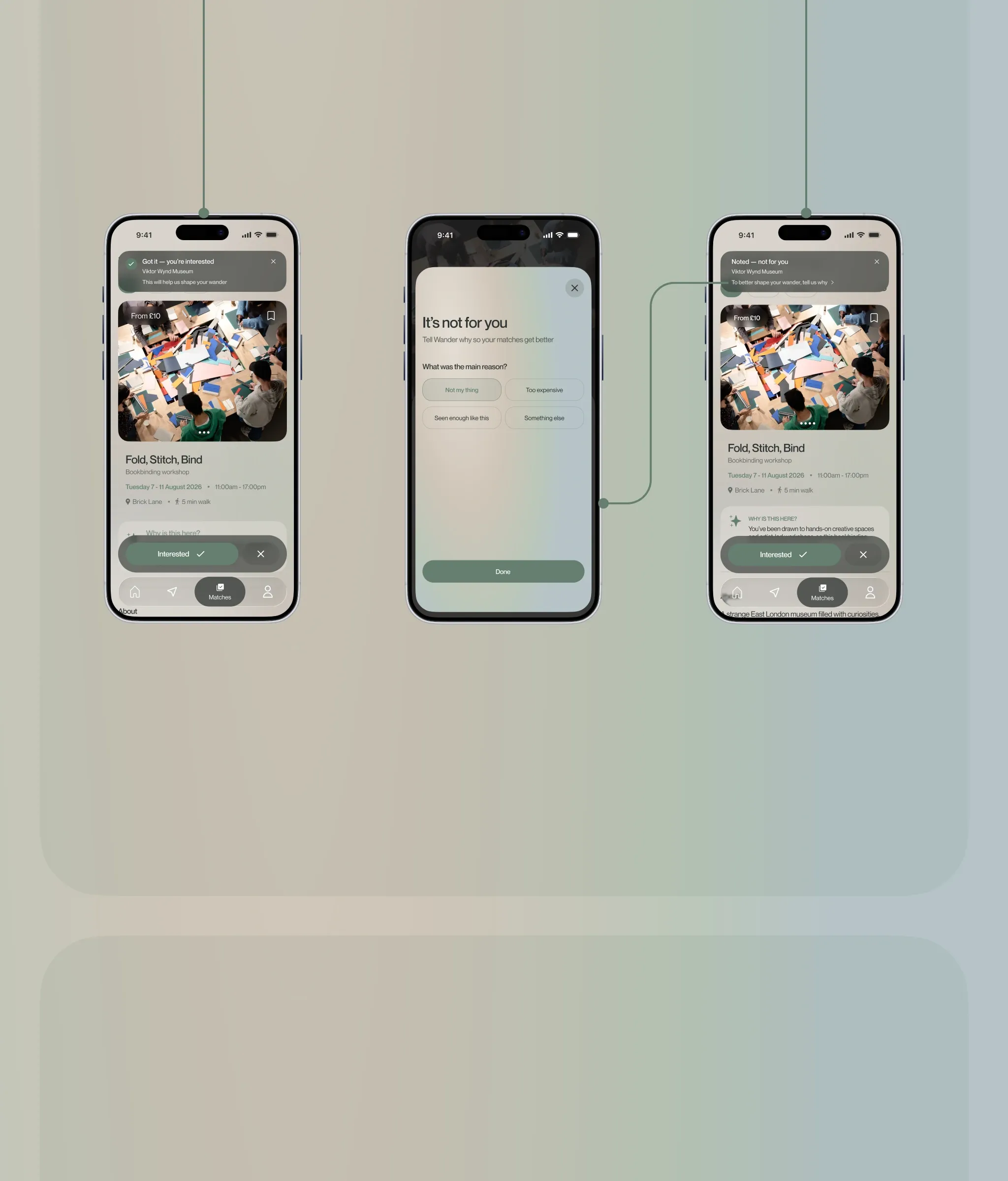
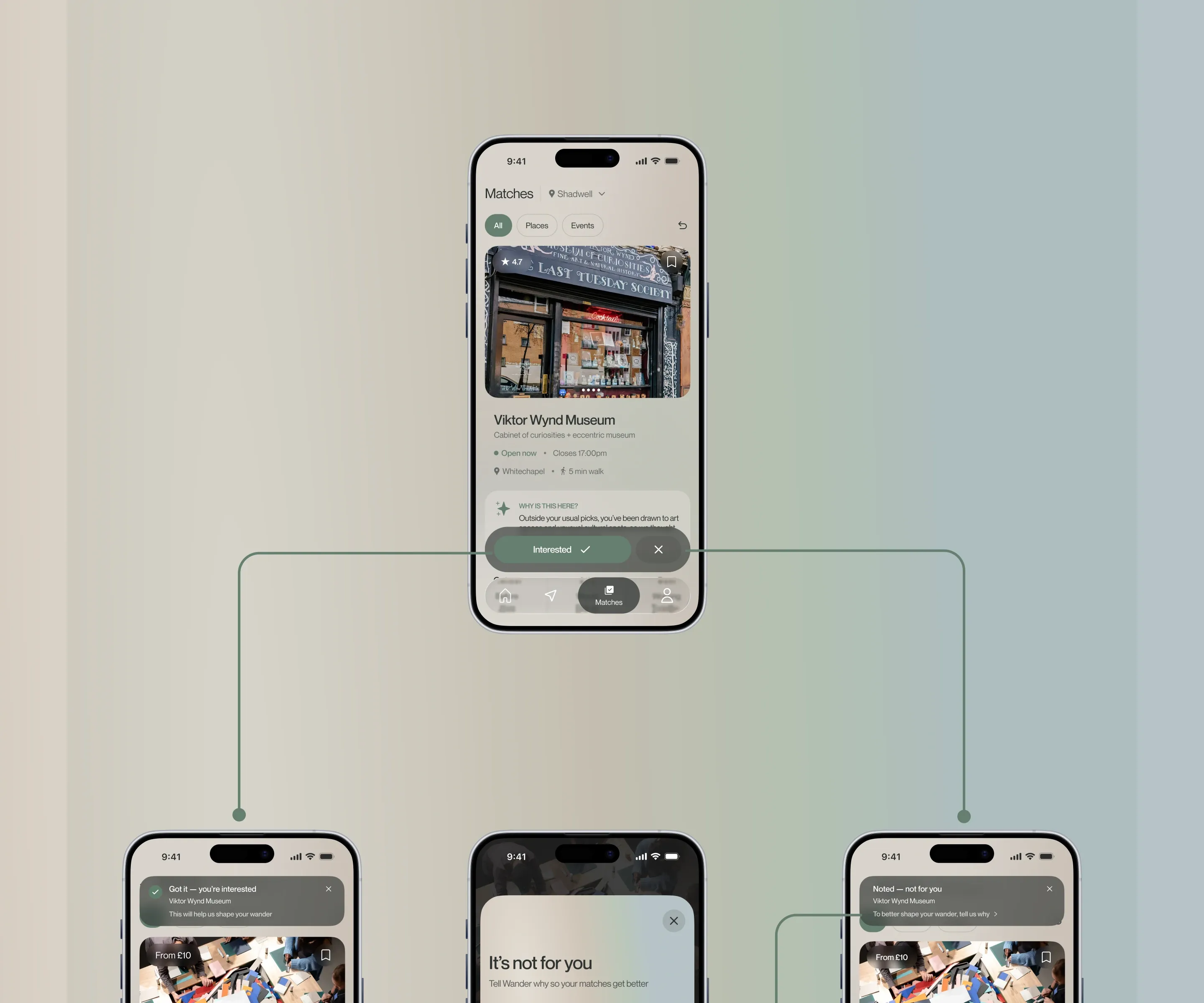
Matches surfaces possibilities worth exploring. Each reaction adds context and sharpens what follows.
Open with a possibility
Each match gives someone something concrete to consider.
Capture interest
A positive response shows what resonates.
Learn from what doesn’t fit
Rejection shapes Wander’s understanding too.
Understand why
A brief reason adds context and sharpens what follows.
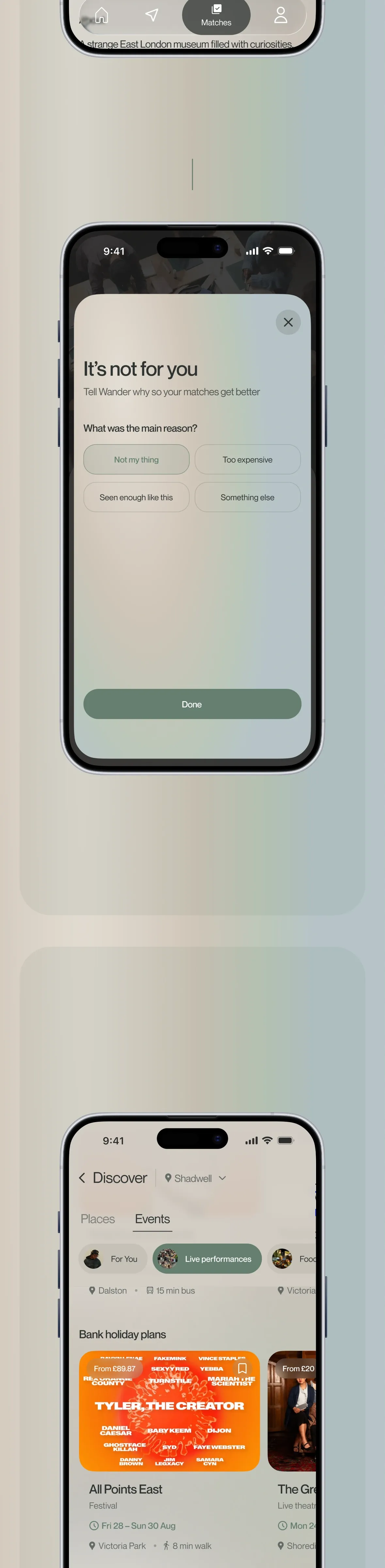
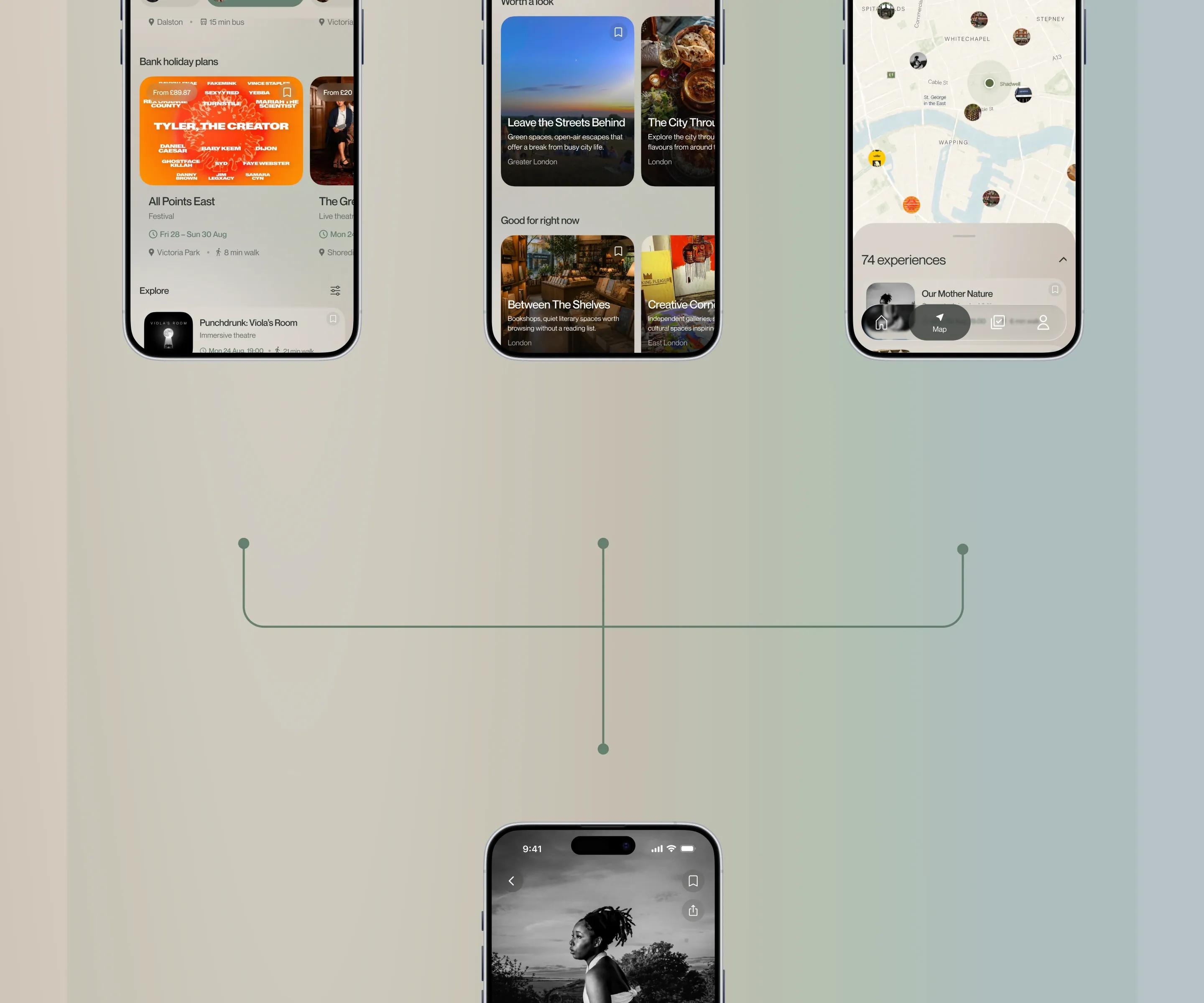
“I want to look around.”
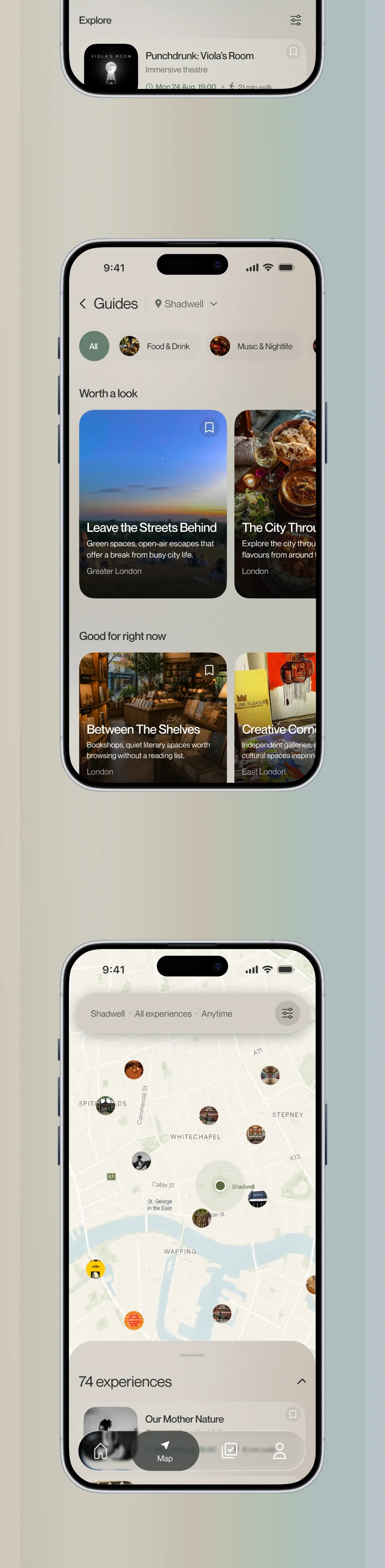
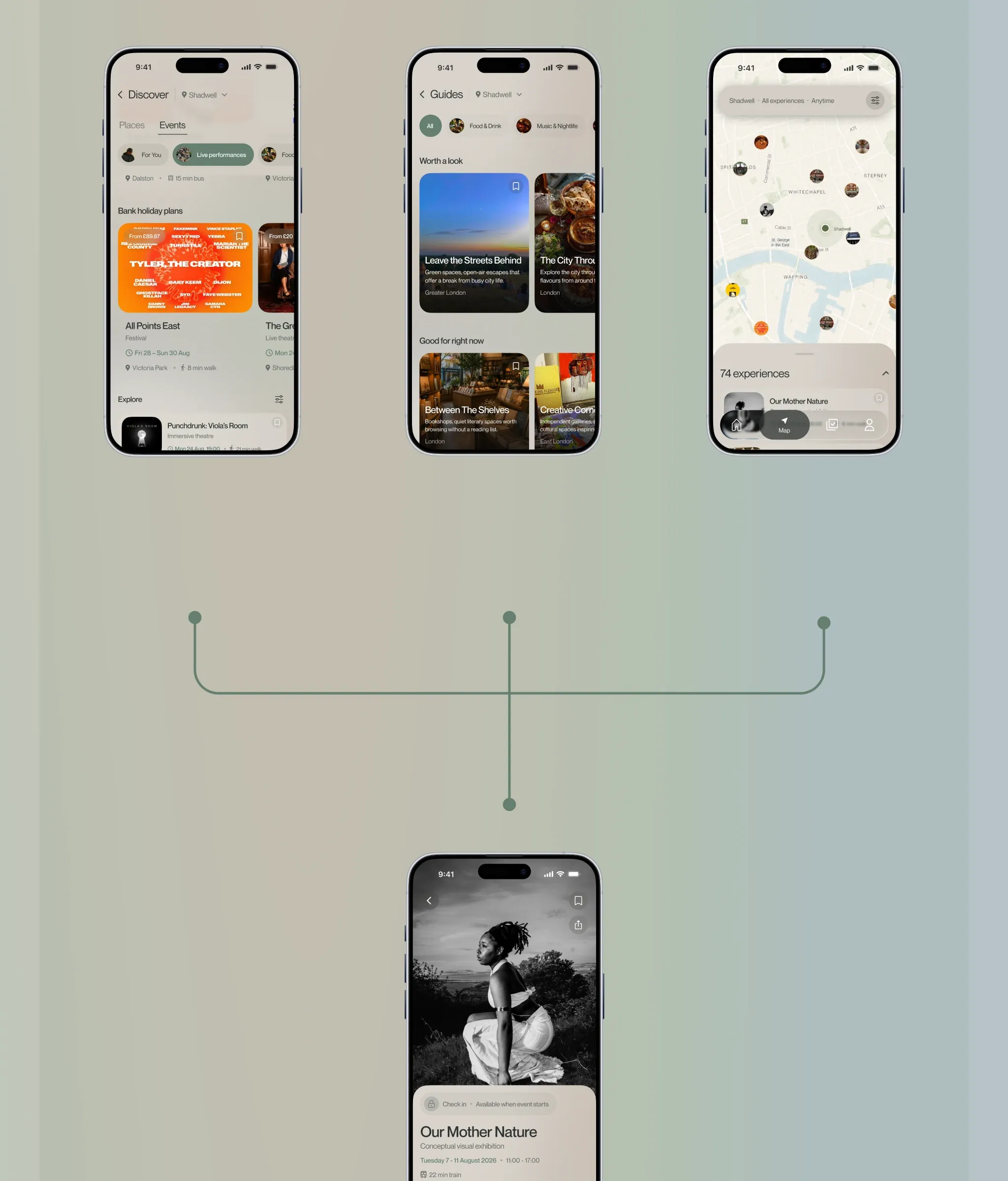
Discover, Guides and Maps offer three parallel ways to narrow the city through interest, curation or location.
Browse by interest
Categories and context give open exploration some shape.
Follow a direction
Guides organise possibilities around a considered point of view.
Explore by location
Maps reveal what is nearby and how each possibility relates.
Move towards a decision
Each route narrows the possibilities until someone finds a place or event worth choosing.
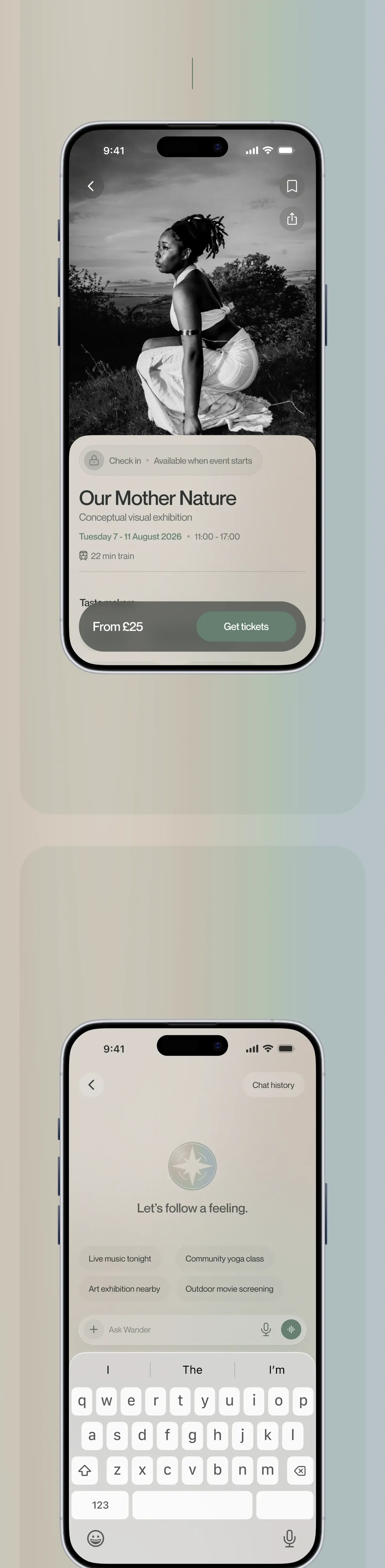
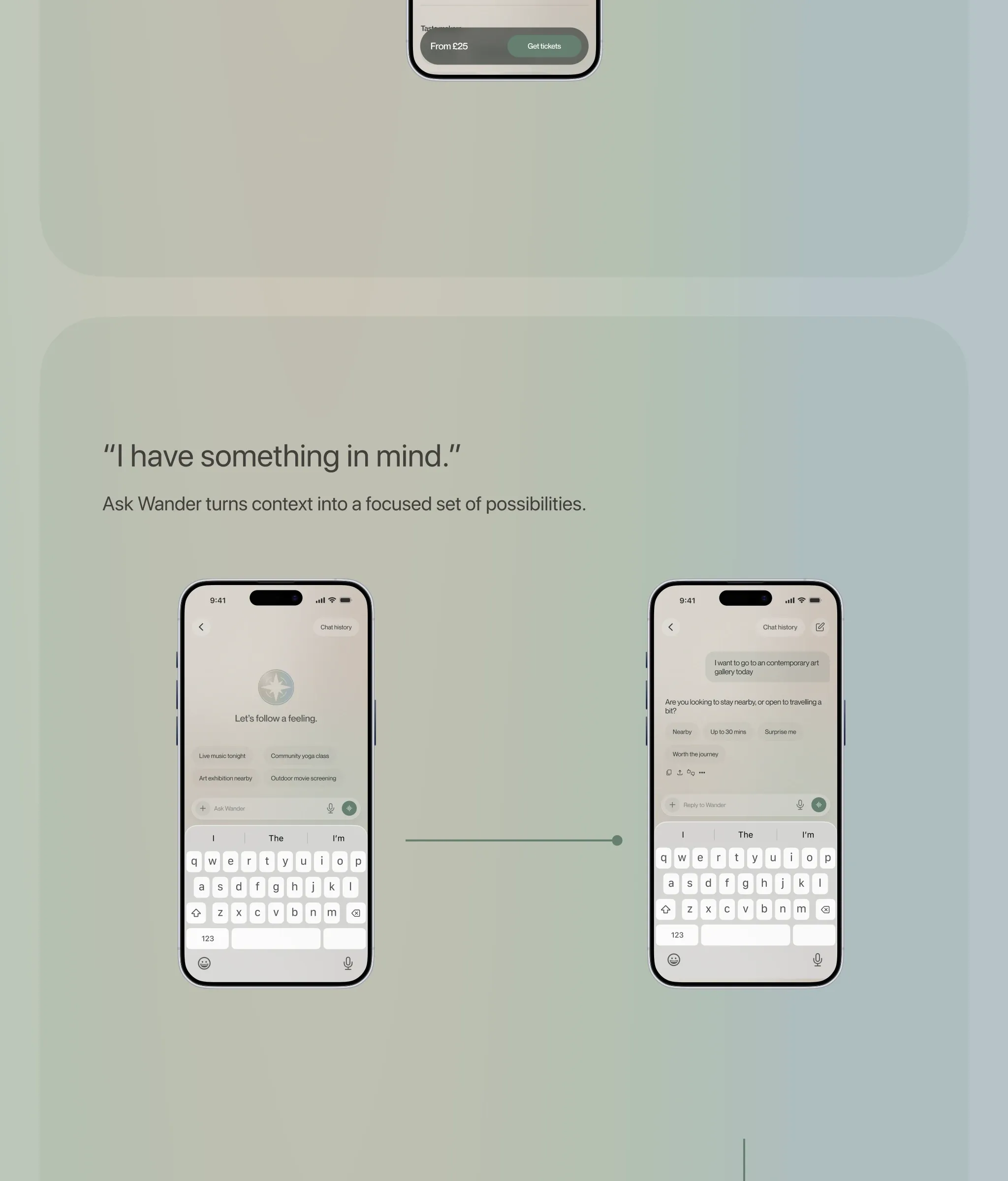
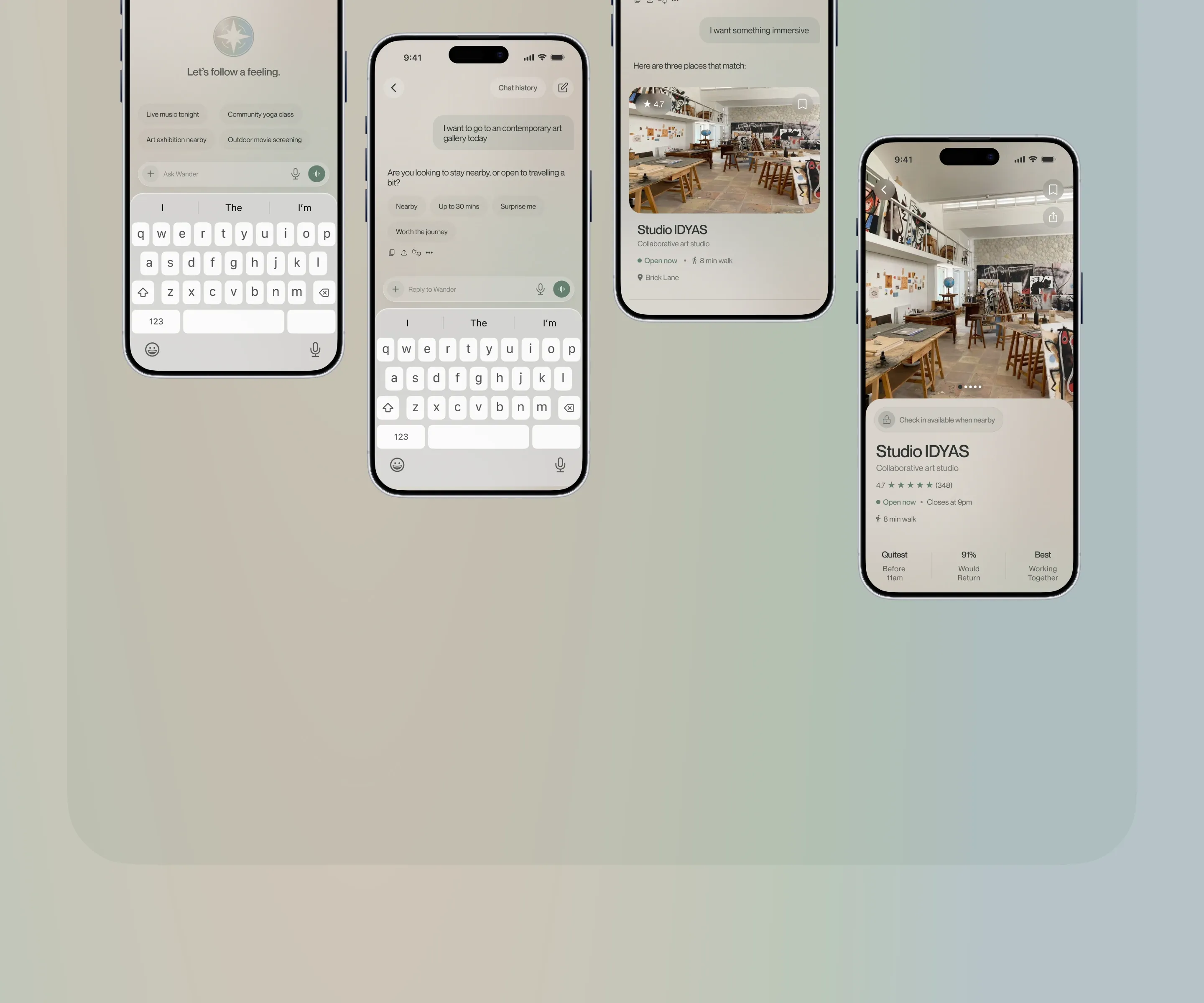
“I have something in mind.”
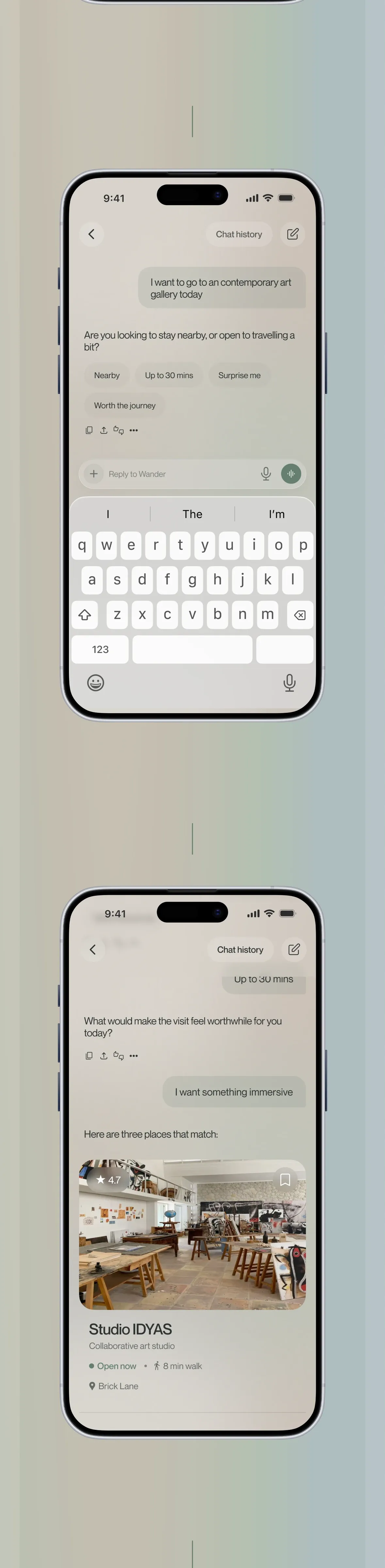
Ask Wander turns context into a focused set of possibilities.
Open with context
Start from the need, not a category.
Clarify the need
Conversation captures what filters miss.
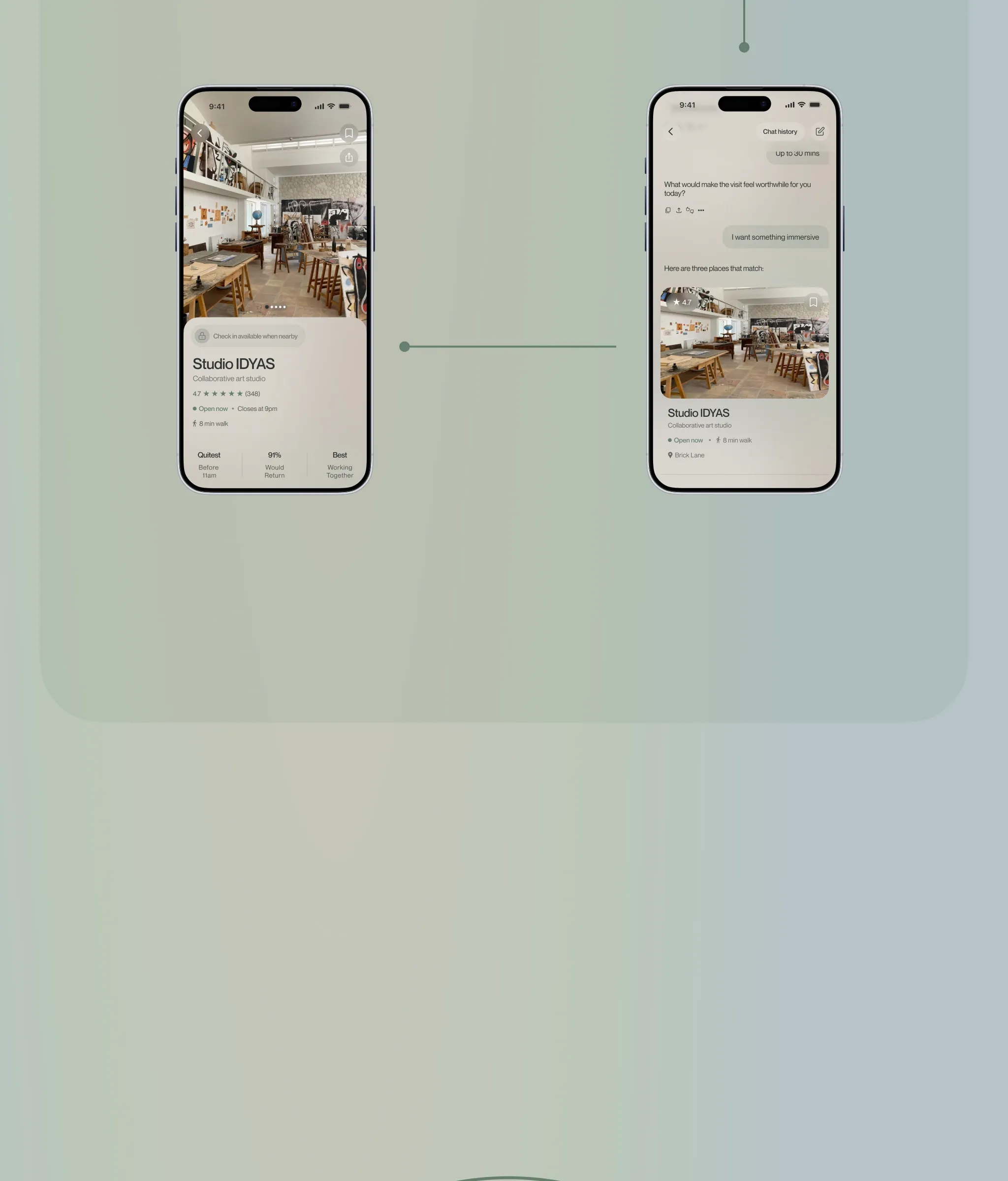
Surface possibilities
A smaller set makes comparison easier.
Move towards a decision
Relevant context replaces more searching.
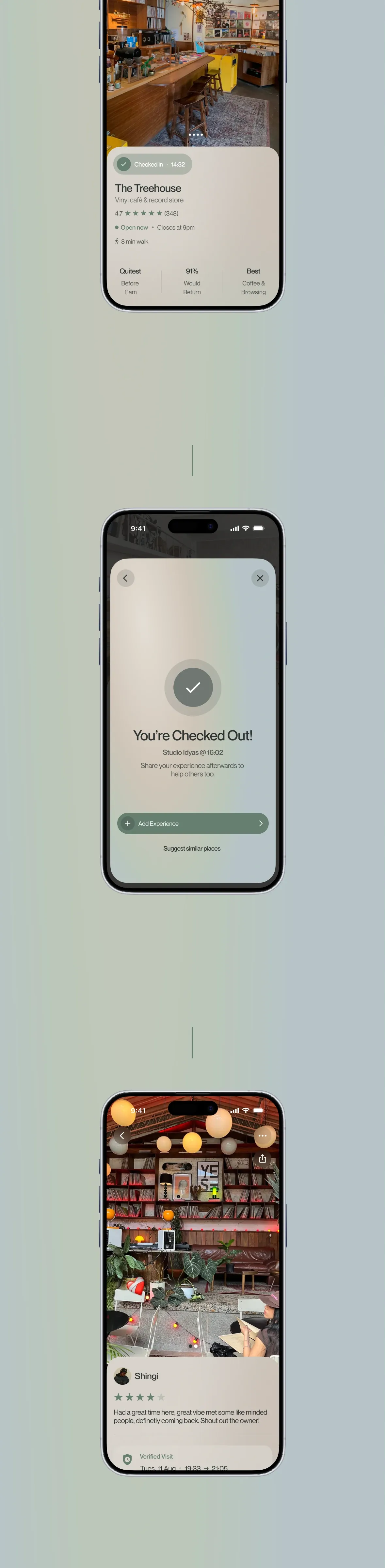
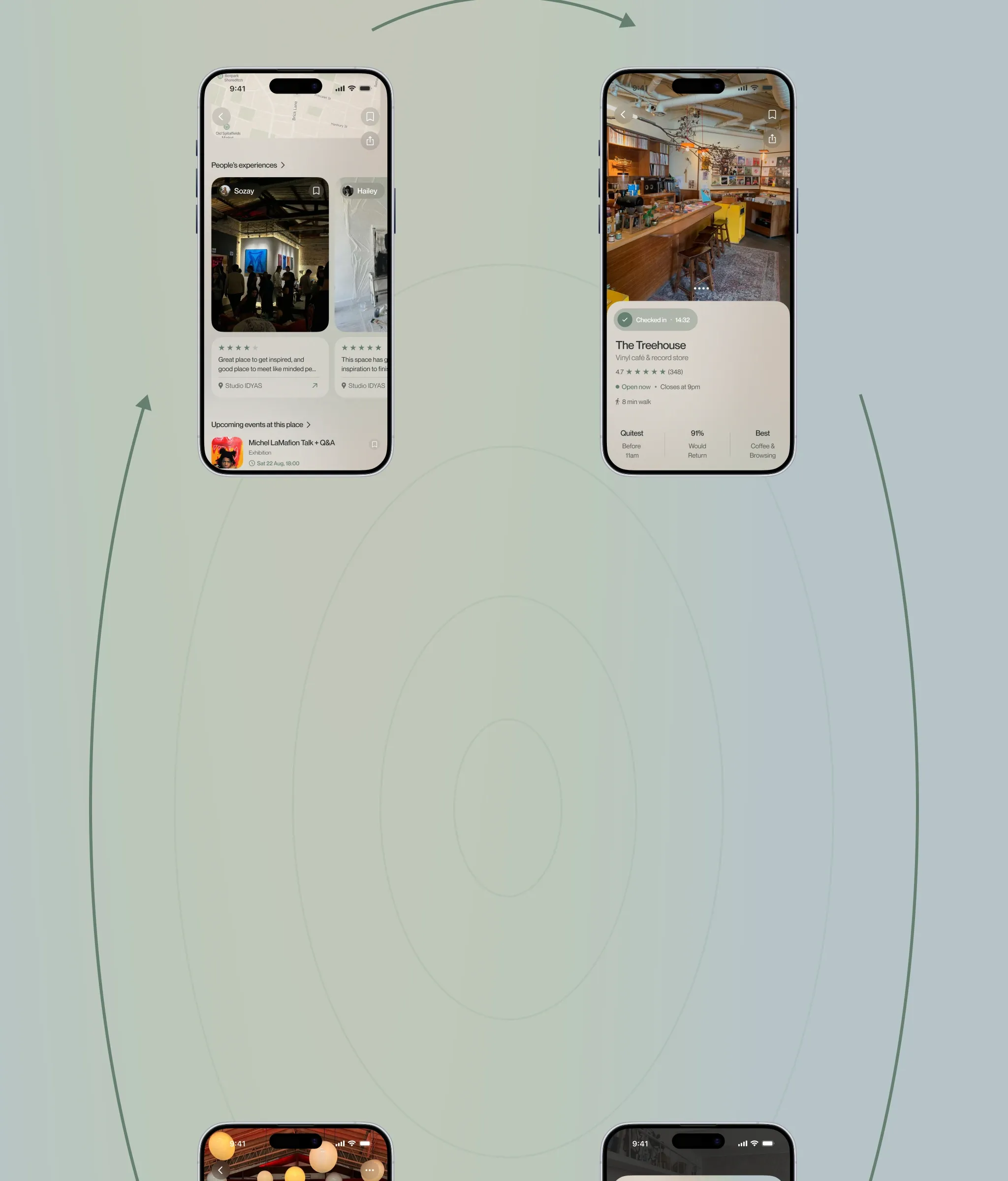
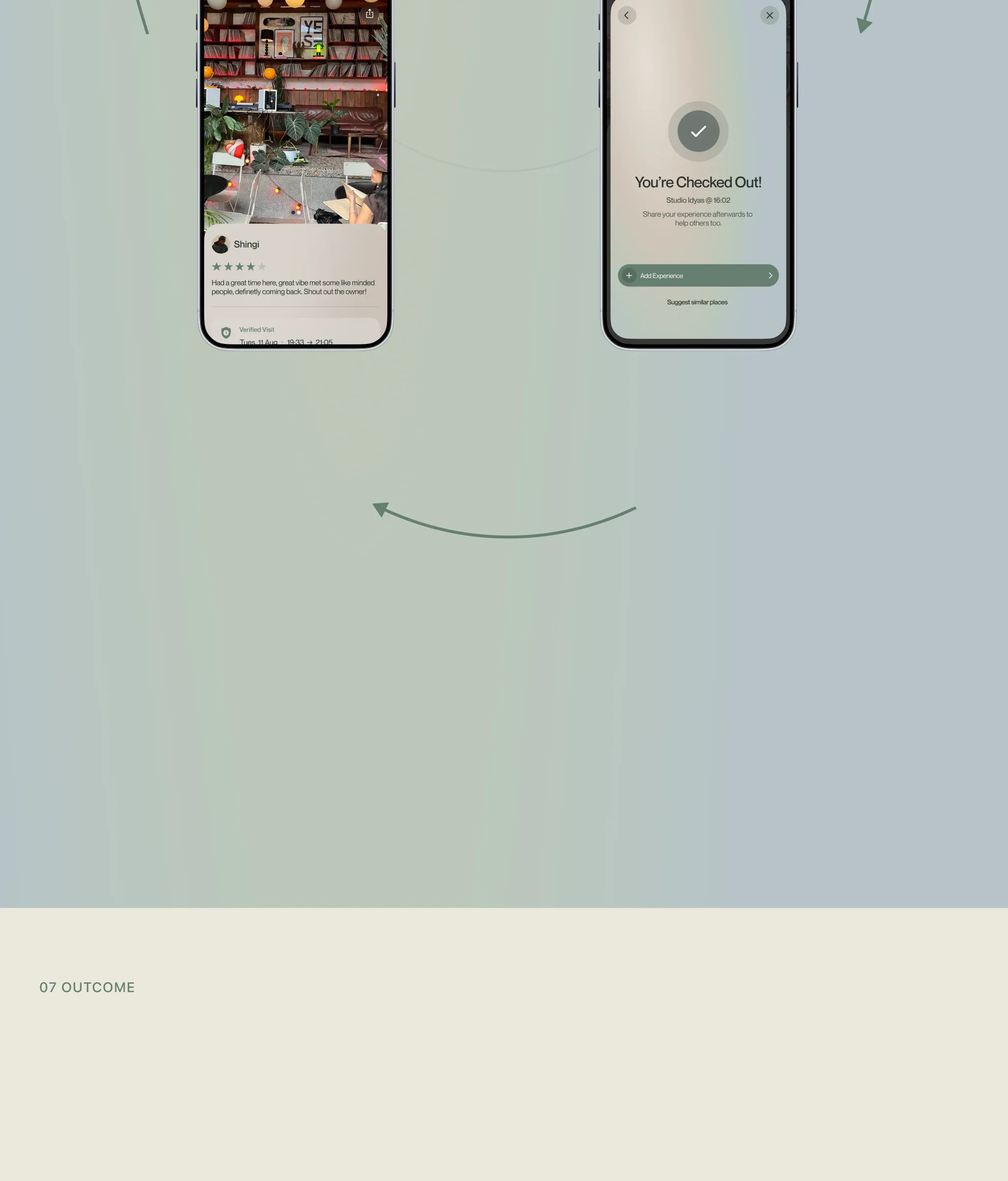
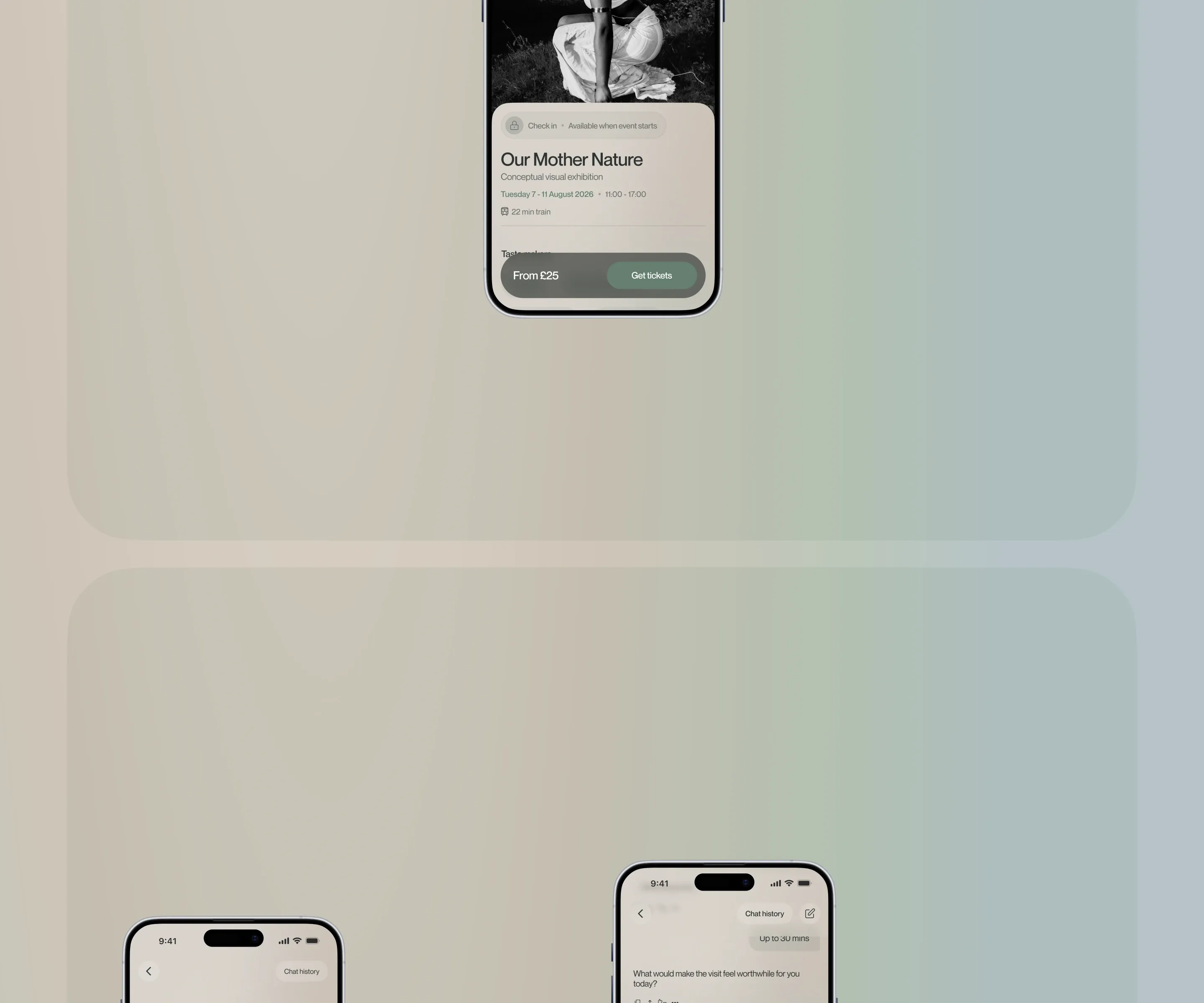
Each visit helps shape the next decision.
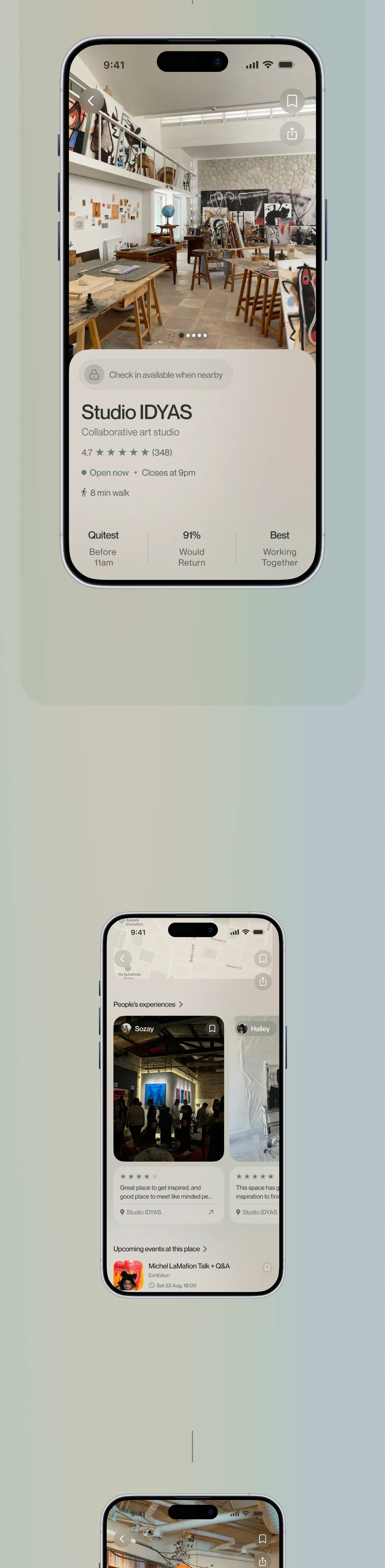
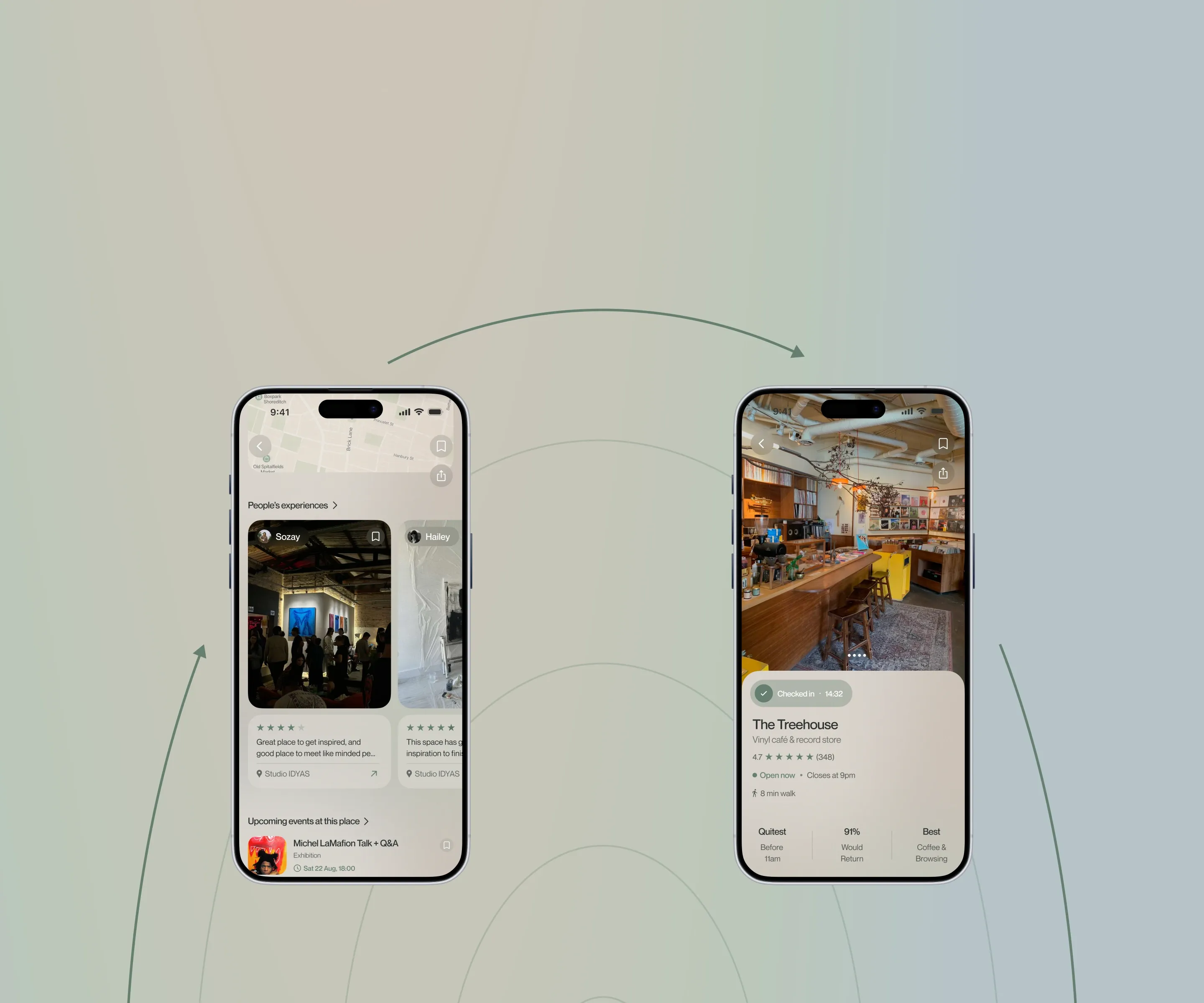
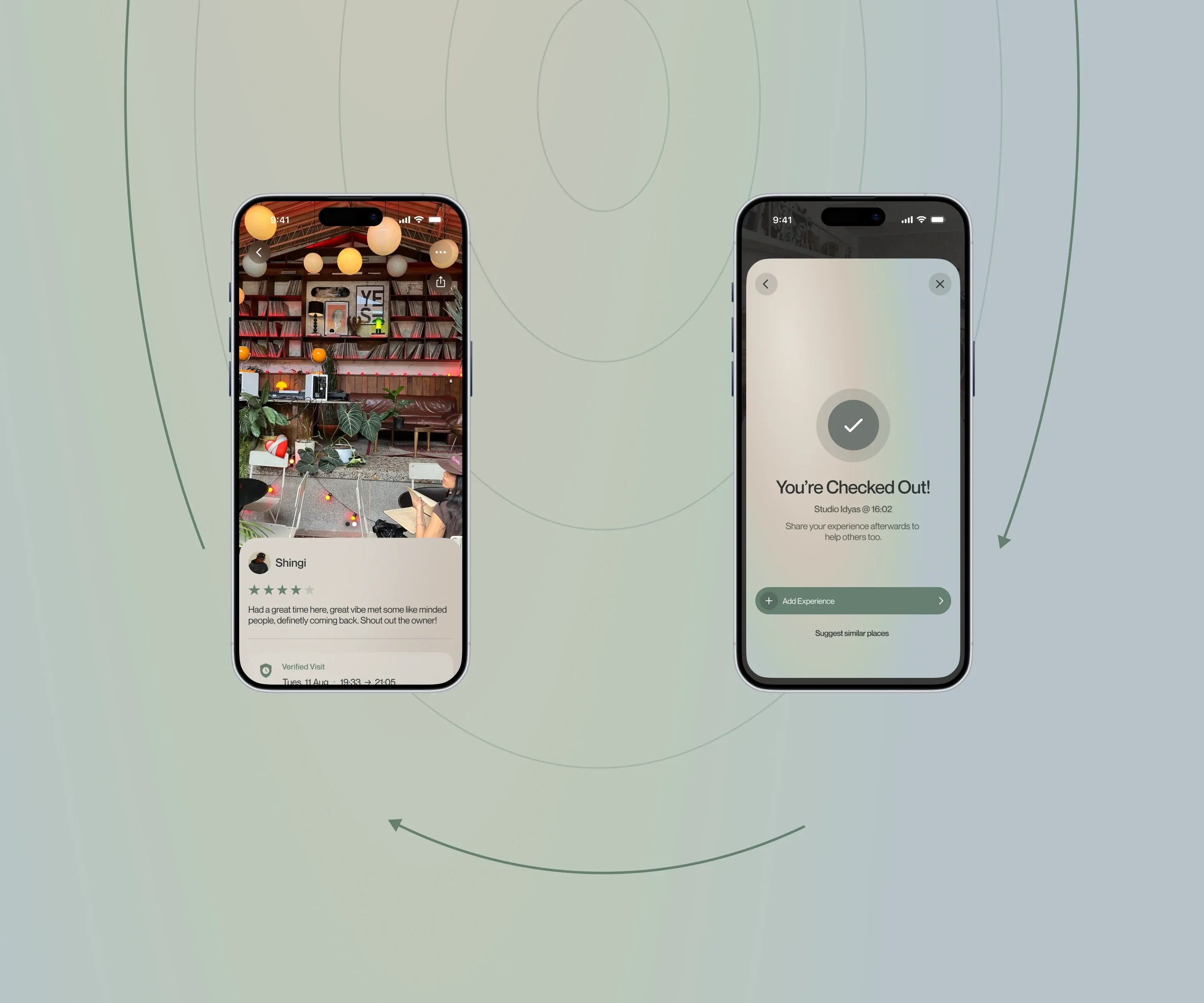
Check-ins confirm which choices became visits; Experiences add context that shapes what follows.
Support the choice
Experiences add lived context to places, before a decision.
Confirm the visit
Checking in and out shows which choices became real visits.
Add your Experience
A confirmed visit unlocks an image-led reflection.
Shape what follows
Your Experience supports another’s choice and deepens Wander’s understanding.
One connected system — learning from what people considered, chose and experienced.
Two lessons reshaped how I approach product thinking:
I mistook breadth for usefulness.
Trying to answer every part of the brief made the product broader, but less valuable. Focusing the MVP on helping someone choose taught me that removing features can create more value than adding them. I’ll carry that forward by treating scope as a product decision—not simply a delivery constraint.
I learned to question the frame, not just work within it.
Reframing the product as a personalised decision engine showed me that how I define a problem shapes the possibilities I can see. I’ll carry that forward by looking beyond what a brief asks for to uncover its deeper purpose.
How I would measure success:
Decision success
Percentage of high-intent sessions leading to directions, ticketing or a verified check-in.
Weekly decision habit
Percentage of users who make a decision on what to do with Wander at least twice a week.
Choice confidence
Change in confidence ratings over repeated use as Wander learns each person’s exploration habits.
Next steps
01. Client Review
Resolve final concerns and agree what should follow the MVP.
02. Developer handoff
Share the prototype and design system, then support implementation.
03. Time-aware dark mode
Deferred rather than rushed; adapt Wander’s atmosphere for evening use.
Not more time in the product. More confidence beyond it.
Next Project
- Giving discovery direction
- Chess social
- Experimental jazz night
- Collaborative art studio
- Bookbinding workshop
- Record browsing
- Product designer
- Product strategy · User research · Prototyping information architecture · UX/UI design
- Client project · Mobile app


Personalised decision engine
Wander
MY ROLE
SCOPE
PROJECT
Product designer
Product strategy · User research · Prototyping information architecture · UX/UI design
Client project · Mobile app
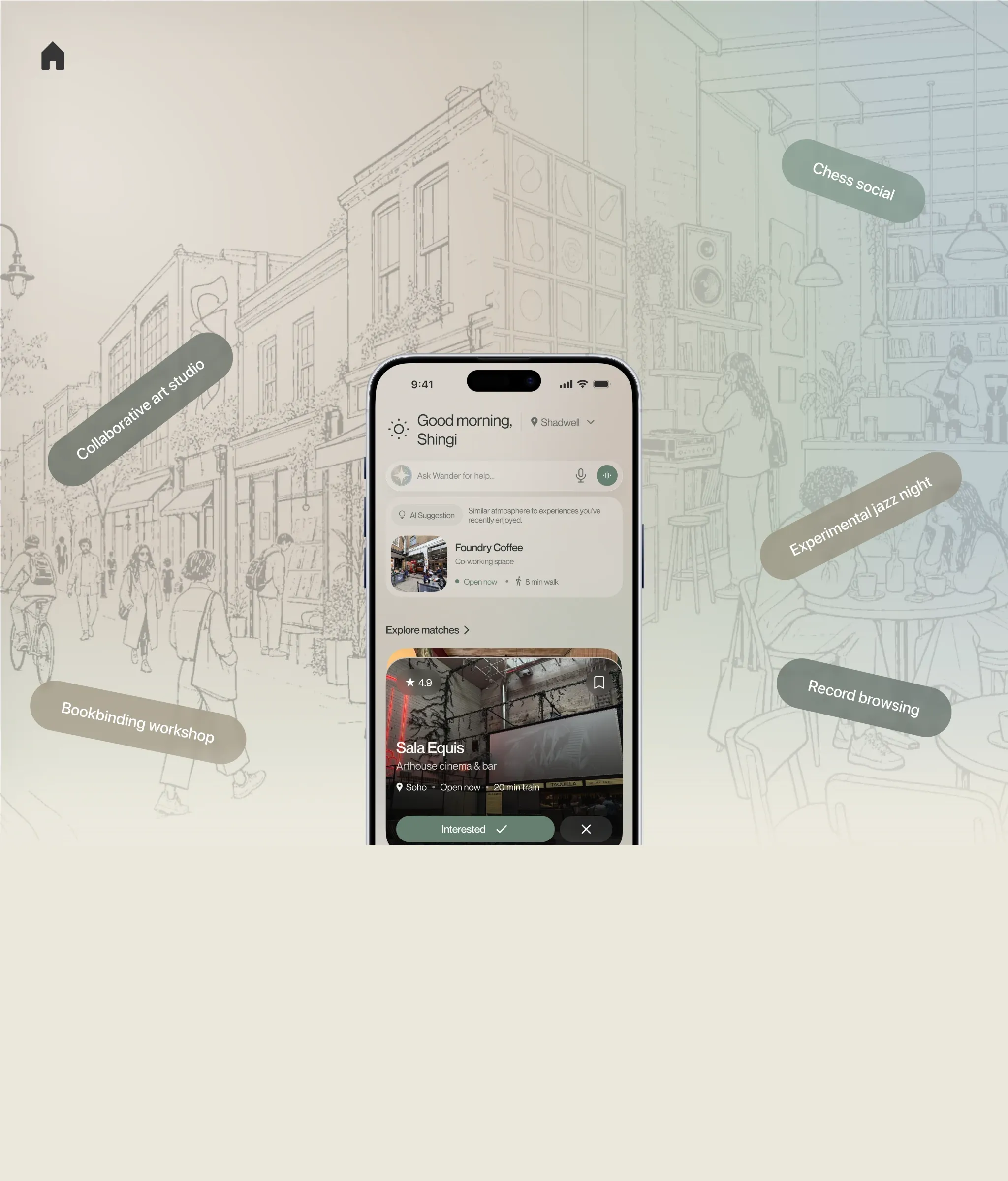
The city is full of possibilities.
But more choice doesn’t always bring better direction. More time searching can mean less time experiencing.
Wander is a personalised decision engine for places and events.
The brief combined personalised recommendations with local and travel discovery, planning tools and detailed decision support.
Turning that promise into a product meant answering three questions:
How should context shape what surfaces?
Which behaviours reveal what genuinely resonates?
What builds confidence to choose?
03 THE FIRST INTERPRETATION - DSCVR
Each direction had a purpose. Together, they encouraged competing behaviours.
DSCVR
Recommended
Named the output
Named the activity
Travel Planning + Documentation
Discovery
Social Content
AI Buddy
Moderated testing with 6 participants also surfaced the gap:
WHAT I INTENDED
WHAT SOME PARTICIPANTS PERCEIVED IN TESTING
Help people discover experiences suited to them.
A travel-focused social discovery app.
Travel planning and social elements were shaping the experience more than discovery.
How might we help people move from exploring places and events to confidently choosing what to do?
04 TRADE-OFFS
Focus meant deciding which behaviours belonged.
01 / City exploration Not trip management.
02 / Decision context Not a social destination.
I mistook serving travellers for needing trip-planning tools. Focusing on urban dwellers clarified the need locals and visitors shared: Finding somewhere worth going.
Social features diluted Wander’s purpose. For the MVP, I kept place-based Experiences to help people decide where to go.
Shared Experiences attached to places
Visitors can still discover a new city
Social Feeds, friends and profile browsing
Itineraries, stamps and journals
Less friend-led discovery, in exchange for community input focused on the decision.
Less trip-management depth, in exchange for a clearer everyday purpose.
Context
Behaviour
Confidence
Signals should be weighted by intent, from passive attention to deliberate choice and real-world action.
Learned taste should be filtered through current time, location and intent.
Knowing why something fits, what it involves and how to act on it builds confidence to choose.
With the scope narrowed, Home had to find its purpose.
INITIAL TEST 1
INITIAL TEST 2
Personalisation began shaping Home
Personalisation felt secondary
Home reflected location more than the person, undermining personalised exploration.
Context and user actions began shaping what appeared, laying the foundations for personalisation, but the routes remained disconnected.
Wander
Recommended
DSCVR
Named the output
Named the activity
Named the evolving journey
The new direction needed a visual language to match.
Matches were also introduced as another learning route for the system.
Home’s hierarchy and layout were refined to fit the new direction.
DSCVR
Wander
Monochromatic palette, flatter hierarchy, beige interface.
Airy atmospheric gradient, clearer visual focus.
I compared how competitors moved from user signal to decision guidance to next action:
SIGNAL
SIGNAL
SIGNAL
Spotify taste + followed artists, venues.
Visited and want-to-try lists + restaurant rankings
Searches, directions, saved places and reviews
GUIDANCE
GUIDANCE
GUIDANCE
Personalised event feed.
Personalised recommendations + Taste Profile
Personalised place answers
NEXT
NEXT
NEXT
Ticket purchase + plans with friends.
Follow-up questions + answer feedback
Further visits + ratings
Learned taste + current context → guidance on what to do next
To build one understanding across the product, users, places and events needed a shared vocabulary.
Shared language
The experience’s qualities
The explorer’s interests
An explainable connection
Taste Makers describe specific qualities beyond a broad category.
The same language describes what someone is drawn to.
Shared qualities help explain why an experience could suit someone.
THE TREEHOUSE
YOUR TASTE
MATCHES
FOOD & DRINK
The same vocabulary makes the connection between person and experience specific.
Core
Adjacent
Stretch
Possibilities aligned with established taste.
Extends familiar interests into something new
Moves beyond established taste while keeping a meaningful connection
That shared vocabulary connected signals from every route, powering a loop that could learn, reflect and guide.
Connected learning loop
01
Learn
Browsing, matches, check-ins, saves and AI conversations signal what someone gravitates towards.
02
Guide
Reflect
Wander combines that understanding with context to surface Core, Adjacent and Stretch possibilities.
The Explorer Profile makes Wander’s understanding visible and editable.
Together, the shared language and learning loop made the product’s understanding specific, visible and correctable, able to explain why something fit, guide a decision and shape what appeared next.
Two final iterations refined Home.
Feedback visible on arrival.
Ask Wander, not AI Buddy.
Keeping Interested and × visible on arrival made Matches feel central and immediately actionable.
AI Buddy became Ask Wander, turning a generic assistant into a branded conversation between Wander and the wanderer.
INITIAL DIRECTION
INITIAL DIRECTION
FINAL ITERATION
FINAL ITERATION
Different levels of certainty needed different ways in
People entered with different levels of certainty. Each route moved them closer to a decision while contributing to what the product understood.
“Show me something I might like”
Matches surfaces possibilities worth exploring. Each reaction adds context and sharpens what follows.
Open with a possibility
Each match gives someone something concrete to consider.
Capture interest
Understand why
Learn from what doesn’t fit
A positive response shows what resonates.
A brief reason adds context and sharpens what follows.
Rejection shapes Wander’s understanding too.
“I want to look around.”
Discover, Guides and Maps offer three parallel ways to narrow the city—through interest, curation or location.
Follow a direction
Explore by location
Browse by interest
Guides organise possibilities around a considered point of view.
Maps reveal what is nearby and how each possibility relates.
Categories and context give open exploration some shape.
Move towards a decision
Each route narrows the possibilities until someone finds a place or event worth choosing.
Open with context
Clarify the need
Start from the need, not a category.
A brief reason adds context and sharpens what follows.
Surface possibilities
Move towards a decision
Conversation captures what filters miss.
Relevant context replaces more searching.
Each visit helps shape the next decision.
Check-ins confirm which choices became visits; Experiences add context that shapes what follows.
Support the choice
Confirm the visit
Experiences add lived context to places, before a decision.
Checking in and out shows which choices became real visits.
Shape what follows
Add your Experience
Your Experience supports another’s choice and deepens Wander’s understanding.
A confirmed visit unlocks an image-led reflection.
One connected system — learning from what people considered, chose and experienced.
Personalisation moved beyond relevant content into guidance for more confident choices.
Two lessons reshaped how I approach product thinking:
I mistook breadth for usefulness.
Trying to answer every part of the brief made the product broader, but less valuable. Focusing the MVP on helping someone choose taught me that removing features can create more value than adding them. I’ll carry that forward by treating scope as a product decision, not simply a delivery constraint.
I learned to question the frame, not just work within it.
Reframing the product as a personalised decision engine showed me that how I define a problem shapes the possibilities I can see. I’ll carry that forward by looking beyond what a brief asks for to uncover its deeper purpose.
How I would measure success:
Decision success
Percentage of high-intent sessions leading to directions, ticketing or a verified check-in.
Choice confidence
Change in confidence ratings over repeated use as Wander learns each person’s exploration habits.
Weekly decision habit
Percentage of users who make a decision on what to do with Wander at least twice a week.
Developer handoff
Client Review
Share the prototype and design system, then support implementation.
Time-aware dark mode
Not more time in the product. More confidence beyond it.
Next Project
- Giving discovery direction
- Chess social
- Collaborative art studio
- Experimental jazz night
- Record browsing
- Bookbinding workshop






Personalised decision engine
Wander
Product designer
Product strategy · User research · Prototyping information architecture · UX/UI design
Client project · Mobile app
The city is full of possibilities.
But more choice doesn’t always bring better direction. More time searching can mean less time experiencing.
Wander is a personalised decision engine for places and events.
02 THE STARTING POINT
The brief promised personalised discovery. We needed a system that could deliver it.
The brief combined personalised recommendations with local and travel discovery, planning tools and detailed decision support.
Turning that promise into a product meant answering three questions:
Which behaviours reveal what genuinely resonates?
What builds confidence to choose?
How should context shape what surfaces?
03 THE FIRST INTERPRETATION - DSCVR
Each direction had a purpose. Together, they encouraged competing behaviours.
DSCVR
Recommended
Named the output
Named the activity
Travel Planning + Documentation
Discovery
Social Content
AI Buddy
Moderated testing with 6 participants also surfaced the gap:
WHAT I INTENDED
WHAT SOME PARTICIPANTS PERCEIVED IN TESTING
Help people discover experiences suited to them.
A travel-focused social discovery app.
Travel planning and social elements were shaping the experience more than discovery.
How might we help people move from exploring places and events to confidently choosing what to do?
04 TRADE-OFFS
Focus meant deciding which behaviours belonged.
01 / City exploration Not trip management.
02 / Decision context Not a social destination.
I mistook serving travellers for needing trip-planning tools. Focusing on urban dwellers clarified the need locals and visitors shared: Finding somewhere worth going.
Social features diluted Wander’s purpose. For the MVP, I kept place-based Experiences to help people decide where to go.
Visitors can still discover a new city
Shared Experiences attached to places
Itineraries, stamps and journals
Social Feeds, friends and profile browsing
TRADE OFF
TRADE OFF
Less friend-led discovery, in exchange for community input focused on the decision.
Less trip-management depth, in exchange for a clearer everyday purpose.
With the focus clear, I turned the original questions into three system rules.
Context
Learned taste should be filtered through current time, location and intent.
Behaviour
Signals should be weighted by intent, from passive attention to deliberate choice and real-world action.
Confidence
Knowing why something fits, what it involves and how to act on it builds confidence to choose.
With the scope narrowed, Home had to find its purpose.
INITIAL TEST 1
INITIAL TEST 2
Personalisation felt secondary
Personalisation began shaping Home
Home reflected location more than the person, undermining personalised exploration.
Context and user actions began shaping what appeared, laying the foundations for personalisation, but the routes remained disconnected.
05 BREAKTHROUGH - WANDER
The product needed one connected learning system to support confident decisions.
Wander
DSCVR
Recommended
Named the activity
Named the output
Named the evolving journey
The new direction needed a visual language to match.
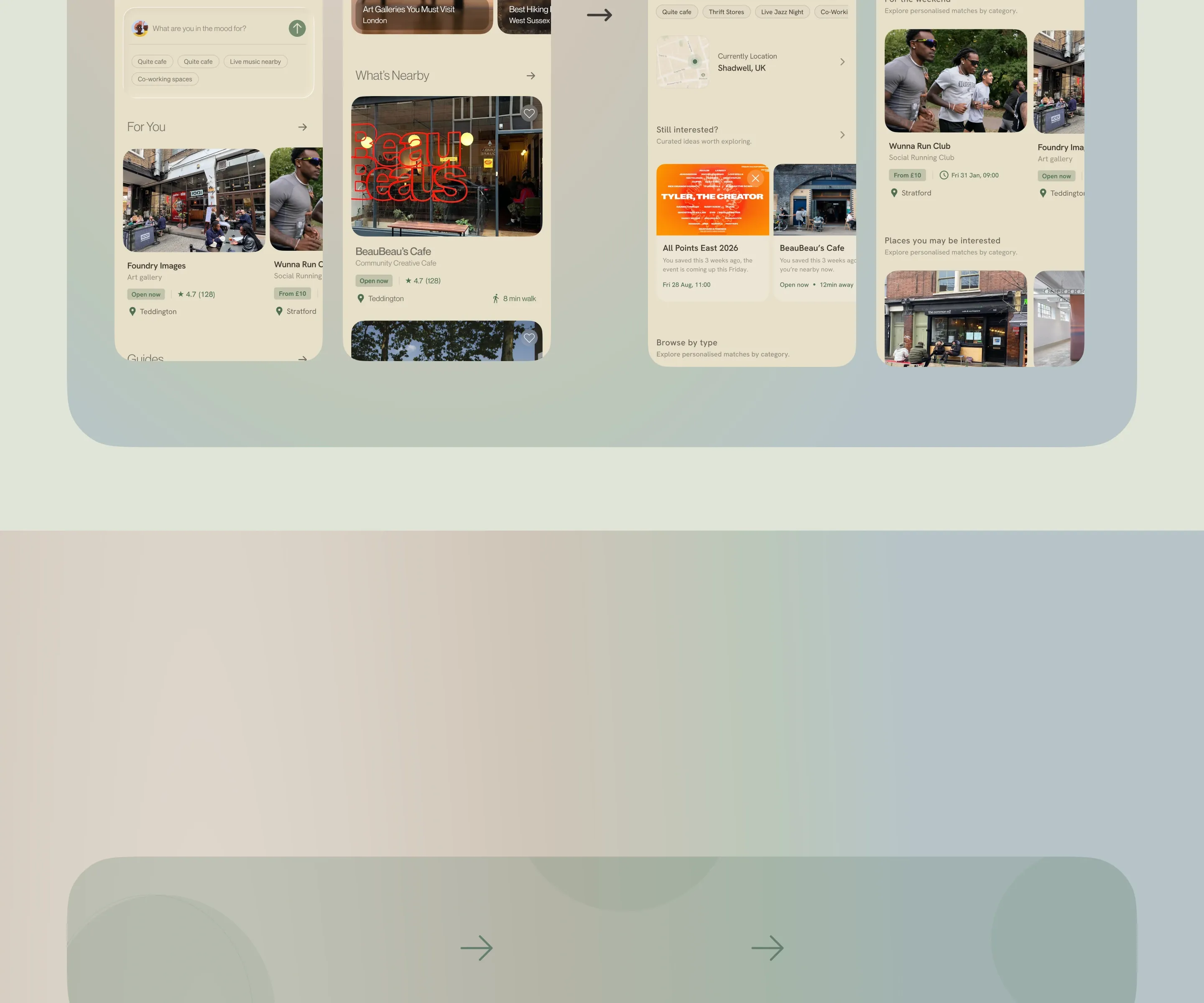
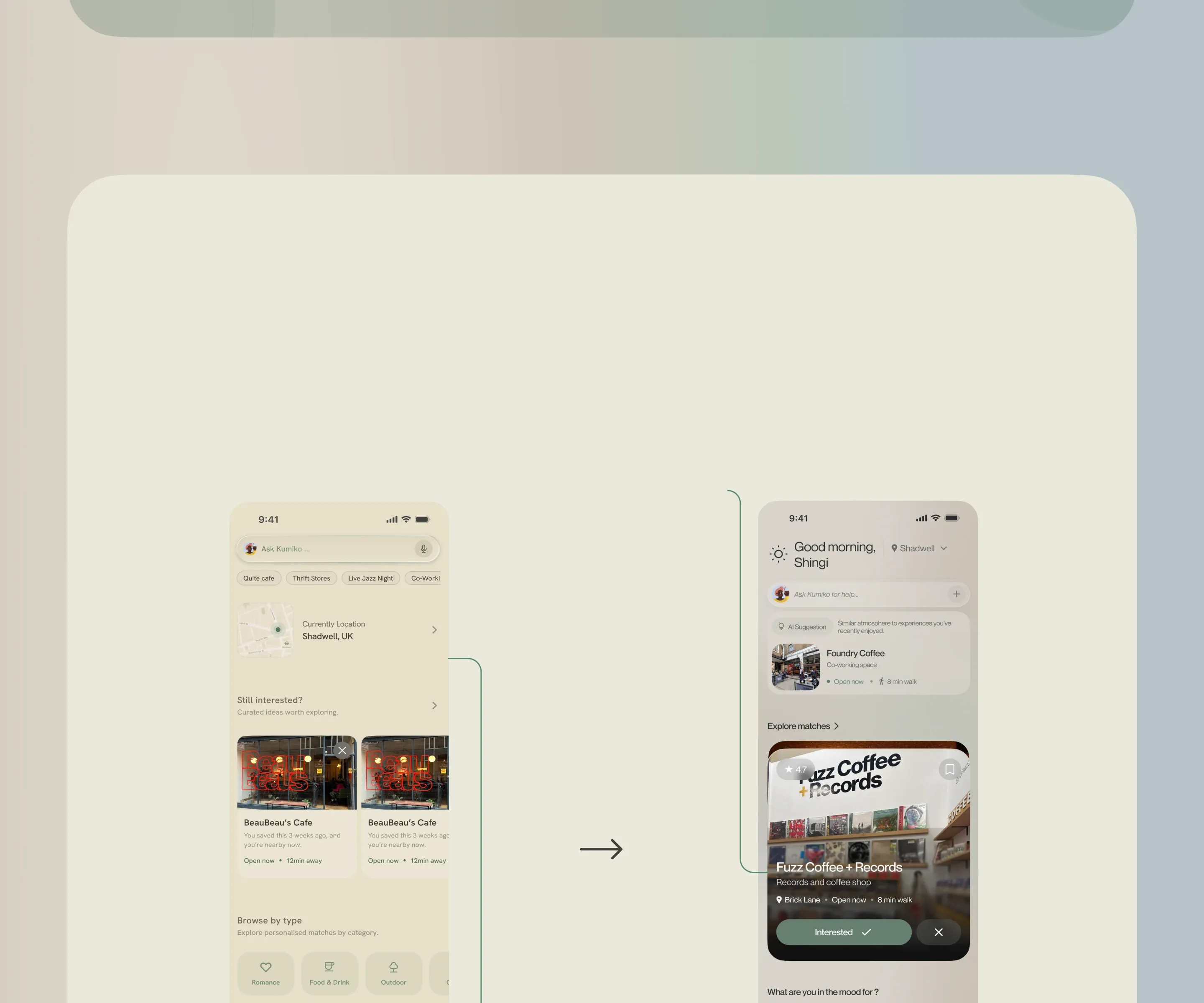
Matches were also introduced as another learning route for the system.
Home’s hierarchy and layout were refined to fit the new direction.
DSCVR
Wander
Monochromatic palette, flatter hierarchy, beige interface.
Airy atmospheric gradient, clearer visual focus.
DICE
Beli
Google / Ask Maps
SIGNAL
SIGNAL
SIGNAL
Spotify taste + followed artists, venues.
Visited and want-to-try lists + restaurant rankings
Searches, directions, saved places and reviews
GUIDANCE
GUIDANCE
GUIDANCE
Personalised event feed.
Personalised recommendations + Taste Profile
Personalised place answers
NEXT
NEXT
Follow-up questions + answer feedback
Ticket purchase + plans with friends.
NEXT
Further visits + ratings
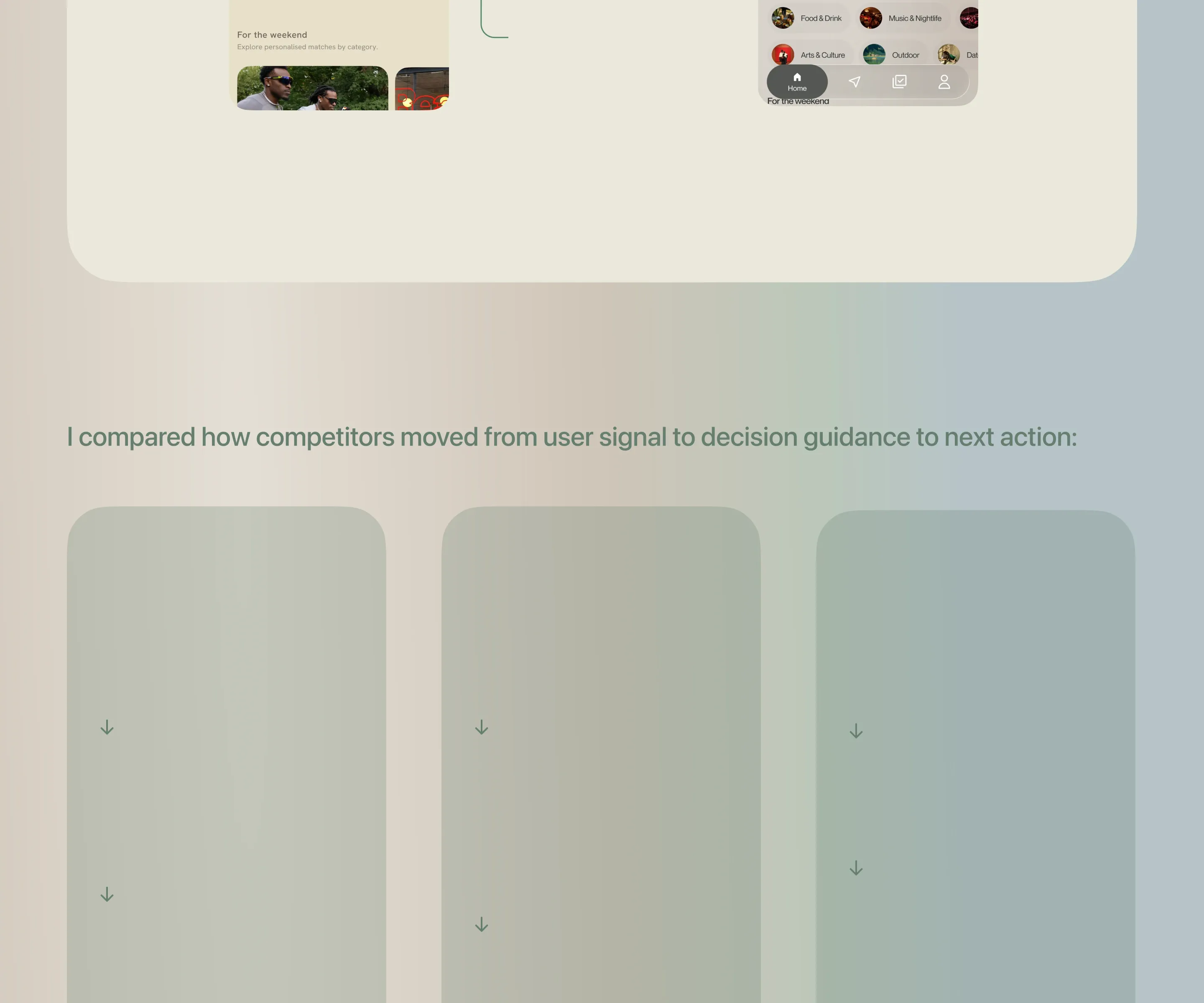
Learned taste + current context → guidance on what to do next
To build one understanding across the product, users, places and events needed a shared vocabulary.
Shared language
Taste Makers describe specific qualities beyond a broad category.
The same language describes what someone is drawn to.
Shared qualities help explain why an experience could suit someone.
THE TREEHOUSE
FOOD & DRINK
YOUR TASTE
MATCHES
The same vocabulary makes the connection between person and experience specific.
Core
Adjacent
Stretch
Possibilities aligned with established taste.
Extends familiar interests into something new
Moves beyond established taste while keeping a meaningful connection
That shared vocabulary connected signals from every route, powering a loop that could learn, reflect and guide.
Connected learning loop
01
Learn
Browsing, matches, check-ins, saves and AI conversations signal what someone gravitates towards.
Deliberate signal
Real-world signal
Implicit signal
Check-ins · Experiences
Matches · Ask Wander (AI) · Saves
Browsing behaviour
02
03
Reflect
Guide
The Explorer Profile makes Wander’s understanding visible and editable.
Wander combines that understanding with context to surface Core, Adjacent and Stretch possibilities.
Together, the shared language and learning loop made Wander’s understanding specific, visible and correctable, helping explain recommendations and shape what appeared next.
Two final iterations refined Home.
Feedback visible on arrival.
Ask Wander, not AI Buddy.
Keeping Interested and × visible on arrival made Matches feel central and immediately actionable.
AI Buddy became Ask Wander, turning a generic assistant into a branded conversation between Wander and the wanderer.
INITIAL DIRECTION
INITIAL DIRECTION
FINAL ITERATION
FINAL ITERATION
06 FINAL SYSTEM
Different levels of certainty needed different ways in
“Show me something I might like.”
Matches surfaces possibilities worth exploring. Each reaction adds context and sharpens what follows.
Open with a possibility
Each match gives someone something concrete to consider.
Capture interest
Understand why
Learn from what doesn’t fit
A positive response shows what resonates.
A brief reason adds context and sharpens what follows.
Rejection shapes Wander’s understanding too.
Follow a direction
Browse by interest
Explore by location
Guides organise possibilities around a considered point of view.
Categories and context give open exploration some shape.
Maps reveal what is nearby and how each possibility relates.
Move towards a decision
Each route narrows the possibilities until someone finds a place or event worth choosing.
“I have something in mind.”
Ask Wander turns context into a focused set of possibilities.
Surface possibilities
A smaller set makes comparison easier.
Open with context
Start from the need, not a category.
Clarify the need
Conversation captures what filters miss.
Move towards a decision
Relevant context replaces more searching.
Each visit helps shape the next decision.
Check-ins confirm which choices became visits; Experiences add context that shapes what follows.
Support the choice
Confirm the visit
Experiences add lived context to places, before a decision.
Checking in and out shows which choices became real visits.
Shape what follows
Add your Experience
Your Experience supports another’s choice and deepens Wander’s understanding.
A confirmed visit unlocks an image-led reflection.
One connected system — learning from what people considered, chose and experienced.
Personalisation moved beyond relevant content into guidance for more confident choices.
Two lessons reshaped how I approach product thinking:
I mistook breadth for usefulness.
Trying to answer every part of the brief made the product broader, but less valuable. Focusing the MVP on helping someone choose taught me that removing features can create more value than adding them. I’ll carry that forward by treating scope as a product decision—not simply a delivery constraint.
I learned to question the frame, not just work within it.
Reframing the product as a personalised decision engine showed me that how I define a problem shapes the possibilities I can see. I’ll carry that forward by looking beyond what a brief asks for to uncover its deeper purpose.
How I would measure success:
Decision success
Percentage of high-intent sessions leading to directions, ticketing or a verified check-in.
Choice confidence
Change in confidence ratings over repeated use as Wander learns each person’s exploration habits.
Weekly decision habit
Percentage of users who make a decision on what to do with Wander at least twice a week.
Next steps:
02
03
01
Client Review
Developer handoff
Time-aware dark mode
Resolve final concerns and agree what should follow the MVP.
Share the prototype and design system, then support implementation.
Deferred rather than rushed; adapt Wander’s atmosphere for evening use.
Not more time in the product. More confidence beyond it.
Next Project
- Giving discovery direction
- Chess social
- Collaborative art studio
- Record browsing
- Bookbinding workshop
- Experimental jazz night
- MY ROLE
- SCOPE
- PROJECT